Picture this. You land in Delhi, check the train to Agra, and every seat is gone. A friendly stranger outside the station says the tourist office is closed, but his cousin’s travel agency can help. Twenty minutes later, you’re paying triple for a ticket you could have booked yourself.
This happens to first-time visitors every season, and almost all of it is avoidable. Indian Railways sets aside a special block of seats for foreign passport holders from the Philippines, Greece, Dominican Republic and you can book them much earlier than the general public. You need to know the quota exists and how to use it.
IVC covers the whole process: the Foreign Tourist Quota (FT Quota), online and in-person booking, the rules that catch people out, and how your India e-Visa connects to all of it. Your train booking and your visa share more than you’d think.
What Is the Foreign Tourist Quota?
The Foreign Tourist Quota is a reserved set of berths on many Indian trains, available only to travelers holding a foreign passport (and NRIs). The big advantage is time. Most Indian passengers can book around 60 days ahead, and popular trains sell out almost immediately. Foreign tourists booking under the FT Quota can reserve up to 365 days in advance, according to IRCTC’s own terms.
A few things worth knowing about how the quota works:
✅️ It applies to reserved tickets only, not unreserved general-class travel.
✅️ Bookings are made in the traveler’s name and cannot be transferred to someone else.
✅️ Authorized IRCTC travel agents cannot book FT Quota tickets. You book it yourself, either online or at an official bureau.
✅️ You need to carry your original passport on the journey. A photo of it won’t do.
✅️ IRCTC lists seven classes for foreign tourists: Executive Chair Car (EC), First AC (1A), Second AC (2A), Third AC (3A), AC Chair Car (CC), Sleeper (SL) and Second Sitting (2S). Not every train runs every class, so the booking screen shows what’s available for your service. Third AC Economy (3E) is not on IRCTC’s list.
✅️ The quota covers many train types, including Shatabdi, Rajdhani, Duronto and Gatimaan. Suvidha trains are excluded.
✅️ The old Indrail Pass, an unlimited travel pass for tourists, was discontinued in 2017. Every journey is now booked as an individual ticket. Though, it describes the pass and lists fares in US dollars, that page looks outdated as of now.
Your India e-Visa and Your Train Tickets Are Linked
Here’s a part most train guides skip. The passport you use to register with IRCTC and the passport you use to board must be the same one tied to your India e-Visa. If your name or passport number on the train ticket doesn’t match your travel documents, you’re inviting trouble at the station and at immigration.
Timing matters too! IRCTC lets you book trains a full year ahead, but the India e-Visa application window opens only 120 days before arrival. That gap catches planners out. It’s tempting to lock in every train the moment you decide to travel, and then discover your India visa hasn’t even been applied for.
A sensible order of operations:
- Apply for your India e-Tourist Visa once you’re within the 120-day window. If you’re not sure about your category or duration, you can check eligibility with IVC Visas first and apply.
- Wait for your status to read GRANTED and download your ETA.
- Then book your trains, using the same passport details.
If you do want to book early to grab a specific train, check the cancellation and refund rules before paying. A rejected visa application with non-refundable train tickets already bought is a painful combination.
Not sure how much time your India visa needs to get approved? Talk to our team and we’ll help you plan around your travel dates.
How to Book Online Through IRCTC (Step by Step)?
Online booking is the easiest route if you’re organised. Here’s how it works.
1. Create or update your IRCTC account.
Go to the official IRCTC website or app. New users register with their details. Existing foreign or NRI users should update their profile with an international mobile number.1.111
2. Verify your phone number.
IRCTC sends an OTP to confirm your international number. Do this well before you need to book, so it isn’t a last-minute scramble.
3. Search for your train.
Enter your stations and travel date, and look for the Foreign Tourist quota option on the booking screen.
4. Enter passenger details.
You’ll need your name as it appears on your passport, your passport number and your nationality. Check every character. A typo here follows you to the platform.
5. Choose your class and confirm availability.
FT Quota seats show up separately from general availability, so a train that looks full may still have tourist seats.
IRCTC lists EC, 1A, 2A, 3A, CC, SL and 2S for foreign tourists, so you’ll see a mix depending on the train.
6. Pay with an international card.
IRCTC’s FT Quota terms say payment must be by international debit or credit card. Alongside the fare, you’ll pay a one-time registration fee and a per-ticket service charge, covered in the next section. Check the total on screen before you confirm.
7. Save your e-ticket. Download the ticket and carry a printed copy or have it ready on your phone alongside your original passport.
⚠️ One honest warning: IRCTC’s website can be slow or glitchy, particularly during peak travel seasons. If the payment page hangs, don’t keep hitting the pay button. Check your bank statement first, the same way you would with any visa fee payment.
What It Actually Costs
This is the part many guides skip, and it affects your budget more than people expect. According to IRCTC’s published Foreign Tourist Quota terms:
- Fare: charged at 1.5 times the normal fare.
- Registration fee: A one-time ₹100 plus GST for international and NRI users, charged when you update your profile and verify your mobile number.
- Service charge: ₹200 plus GST per ticket, on top of the fare.
- Payment: international debit or credit card only.
- Cancellation: a flat 50% of the fare is deducted on top of the usual cancellation charges. The refund has to be requested through the website, up to four hours before departure. Waitlisted and RAC tickets follow the general quota’s cancellation rules.
The terms page is an older document, so treat these numbers as the published position and trust the final amount on the booking screen. But budget for foreign-quota tickets costing noticeably more than the local fares quoted in many blogs and forums.
🚨The 365-Day Catch
You can book up to 365 days ahead, but Indian Railways currently opens reservations 60 days ahead. If you book beyond that window, your berth isn’t allotted at the time of booking. It’s allotted when your travel date comes within the 60-day window. If the railway system can’t allot a berth, the ticket is cancelled automatically and you’re refunded.
In practice, booking six months out gets you a place in the queue, not a confirmed seat on the day you pay. Boarding point changes and ticket printing are only possible after a berth has been allotted. For popular overnight routes in peak season, keep a backup plan.
Booking in Person: The International Tourist Bureau
If online booking fails, or you simply prefer a person across a desk, head to an International Tourist Bureau. According to Indian Railways’ tourist facilities page, the offices officially called International Tourist Bureaus are in New Delhi and Varanasi. They help foreign tourists and NRIs with enquiries, bookings and travel planning.
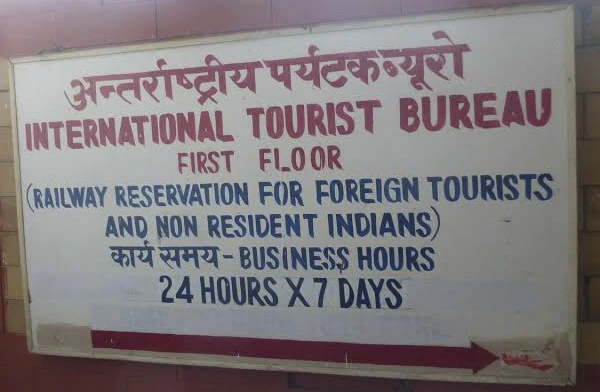
The best-known one sits on the first floor of New Delhi Railway Station, on the Paharganj side. Other cities have similar counters, including Mumbai, Kolkata, Chennai, Agra, Jaipur and Varanasi. The railway’s own enquiry site lists current locations, and there’s also a rail booking desk at Delhi’s international airport.
What to bring?
- Your original passport with a valid India visa
- A printout or screenshot of your India e-Visa ETA, just in case
- Your planned route and dates, written down
- Payment: bureaus have traditionally accepted foreign currency such as US dollars, euros and pounds, as well as rupees
Opening hours have been reported differently across sources, so look up the current times for your station before you go. You’ll often get a seat from the tourist quota even when a train is fully booked for Indian passengers, which is the whole point of the bureau.
The “Office Is Closed” Scam
This one deserves its own section, because it’s so common around New Delhi station. Someone approaches you, often looking official, and tells you the tourist bureau has closed, moved or burned down. He then points you to a private agency nearby.
Ignore it!
Walk to the first floor of the station building and see for yourself. Private agencies can’t legally sell you FT Quota seats anyway, so whatever they sell is either overpriced or a different quota entirely.
A few other habits that keep you safe:
- Book through IRCTC or an official bureau, not a street agent.
- Never hand over your passport to anyone outside an official counter.
- If someone says your train is cancelled, check the status yourself on the IRCTC app or the station display board.
What the FT Quota Can’t Do
Knowing the limits saves frustration. IRCTC’s terms for the quota rule out:
🚩 Name changes. The ticket stays with the person and passport it was booked for.
🚩 Concessions. None apply to FT Quota tickets.
🚩 Agent bookings and i-tickets. You book it yourself.
🚩 Travel insurance and the Vikalp alternate-train option. Neither is available on FT Quota bookings.
🚩 Suvidha trains. They’re excluded from the quota.
🚩 Changes before a berth is allotted. Boarding point changes and ticket printing only work once your berth is confirmed.
The quota is also limited, so popular routes still fill in peak season (October to March), and Tatkal and last-minute rules are separate. Holding a foreign passport doesn’t guarantee a last-minute seat.
Planning Common Tourist Routes
Most first trips follow a handful of well-worn corridors. A few examples:
- Delhi to Agra: One of the shortest and most popular hops, with fast morning trains that make a day trip to the Taj Mahal realistic.
- Delhi to Jaipur: A comfortable half-day journey by fast train, usually the next step on the Golden Triangle.
- Mumbai to Goa: An overnight or long-day journey that rewards early booking, since beach season fills it quickly.
Longer routes between regions, say Delhi to Kerala, often make more sense as a short domestic flight. Mixing trains and flights is how most experienced visitors cover India’s distances.
🚨 If you do want to book early to grab a specific train, think carefully first. Cancelling an FT Quota ticket costs a flat 50% of the fare on top of normal charges, so a rejected or delayed visa after you’ve bought tickets is an expensive problem, not a minor one.
The visa matters on the train itself too. IRCTC’s terms say you must carry your original passport with a valid visa during the journey. If you can’t show them, you can be treated as travelling without a ticket and charged a penalty of three times the fare. Every passenger on a booking must carry their own passport and visa. With an India e-Visa, that means your passport plus a printout of your approved ETA, kept together.
Where IVC Visas Fits In?
Train tickets and visas feel like separate chores, but they fail in the same ways: mismatched names, wrong passport details, rushed timing. We see it constantly. An applicant enters a nickname instead of the passport name, or applies days before a flight with a train already booked, and the whole itinerary wobbles.
At IVC Visas, we review your India e-Visa application before it reaches the government portal. We check your photo, passport scan and category, so the visa part of your trip doesn’t become the weak link. If your dates are fixed and your train tickets are already in hand, start your India e-Visa application early and leave yourself room to fix anything that comes up.

India has been waiting. Your India e-Visa is the only step away!
Contact IVC in case of any queries!
Disclaimer: IVC Visas is an independent visa service provider. We assist with application preparation and submission to official government portals. Final visa approval decisions are made solely by Indian immigration authorities. All information is based on current regulations as prescribed by the Government of India, which may change. Always verify the latest requirements before travel.