Getting your India e-Visa approved is one part of arriving in India. Clearing customs is a separate process, governed by its own rules, forms, and consequences for getting it wrong. Many India e-Visa travelers assume that once their visa is granted and their passport is stamped, the paperwork is done. It isn't. What's in your bags is a different question from what's in your passport, and India's customs authority - the Central Board of Indirect Taxes and Customs (CBIC), treats it that way.
This guide covers everything an India e-Visa holder needs to know about customs:
Before you pack, at the airport on arrival, and what to do if something goes wrong. All figures are sourced from CBIC's official International Travel Guide, updated February 2026, and the Baggage Rules 2026.
First - Customs Is Not Immigration, and Your India e-Visa Doesn't Cover It
Your India e-Visa authorizes you to enter India. It says nothing about what you're bringing with you. Immigration checks your identity and travel authorization; customs checks your baggage. They are two separate counters, two separate sets of rules, and two separate government processes even though they happen minutes apart on the same trip.
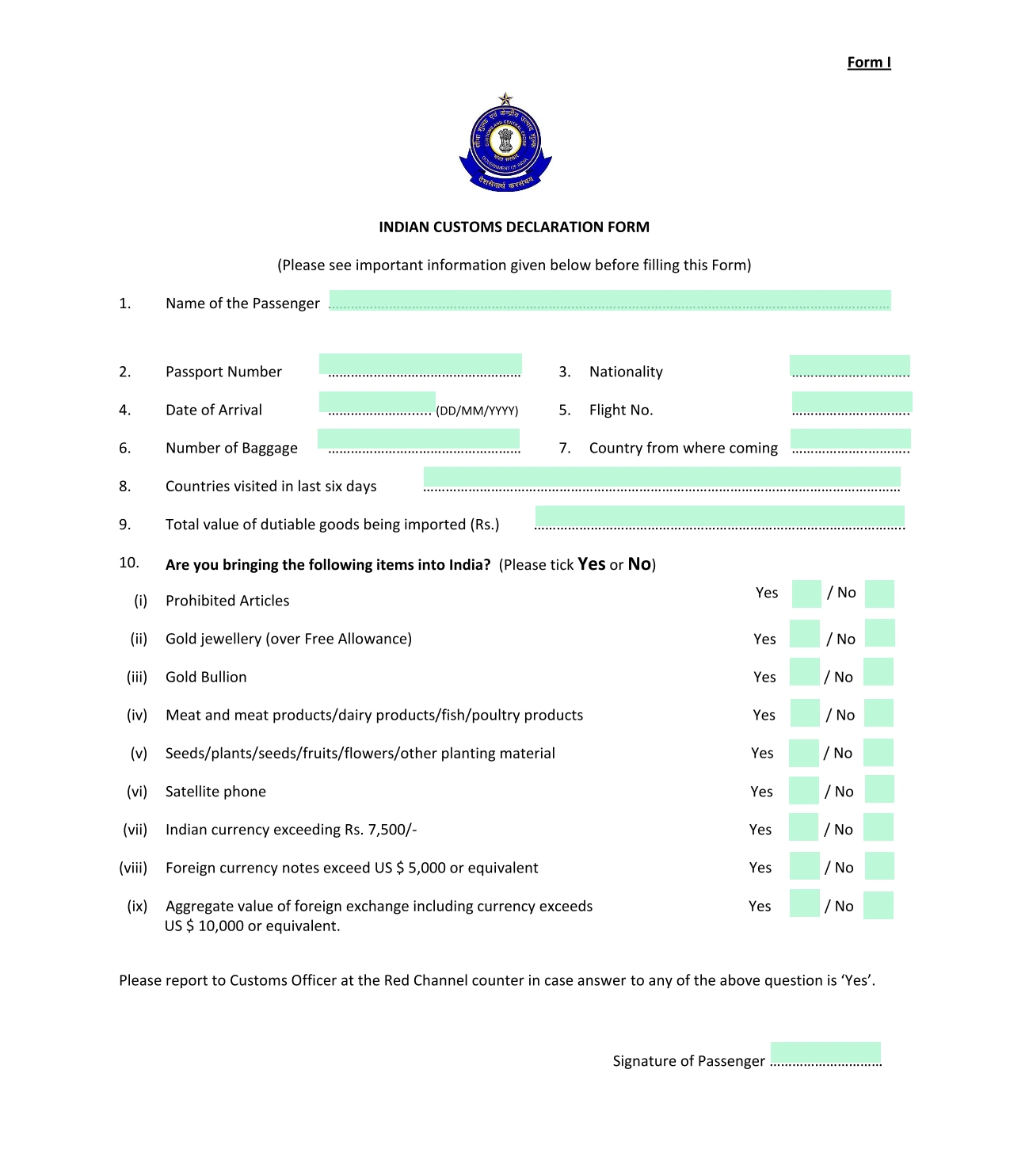
This distinction matters because a perfectly valid India e-Visa does not protect you from customs duty, confiscation, or penalties if your baggage doesn't comply with India's import rules. Equally, the mandatory e-Arrival Card, required for all foreign nationals of Spain, UAE, Cuba and other eligible countries entering India since April 2026, is an immigration and disembarkation document. It is not a customs declaration. The Indian Customs Declaration Form (CBD-I) is a separate form covering baggage and goods value specifically.
Your Duty-Free Allowance as an India e-Visa Holder
Under the CBIC Baggage Rules 2026, effective from February 2, 2026, the General Free Allowance depends on your visa type:
📌 Foreign tourists on an India e-Visa (tourist category): Duty-free allowance of ₹25,000; raised from the previous ₹15,000 limit.
📌 Foreigners holding non-tourist visas (business, employment, and certain other categories), as well as Indian residents, NRIs, and OCI cardholders: Duty-free allowance of ₹75,000; raised from the previous ₹50,000 limit.
This allowance covers used personal effects, gifts, and souvenirs you're bringing into India, plus specific allowances for alcohol and tobacco within that value:
- Alcohol: up to 2 litres combined (beer, wine, or spirits)
- Tobacco: up to 100 cigarettes, or 25 cigars, or 125 grams of tobacco
These quantities must fall within your overall duty-free value limit. Anything above these thresholds in value or quantity must be declared at the Red Channel and will attract duty.
📌 One detail that catches families off guard: this allowance is strictly individual. You cannot pool your ₹25,000 with a travelling companion or family member to bring in one higher-value item. Each India e-Visa holder gets their own separate allowance.
📌 Personal electronics like phone, laptop, camera, tablet are allowed for personal use without declaration, separate from the general allowance. One used laptop is permitted duty-free in addition to the general allowance for any passenger above the age of 18. Additional or new electronics beyond personal-use quantities may require declaration.
Green Channel or Red Channel: Which One Is Yours?
Every arriving passenger in India chooses between two exits after collecting baggage:
🟩 Green Channel is for passengers with nothing to declare. If your baggage is within your duty-free allowance, contains no prohibited or restricted items, and you're not carrying currency or gold above the declaration thresholds, you walk through the Green Channel without stopping.
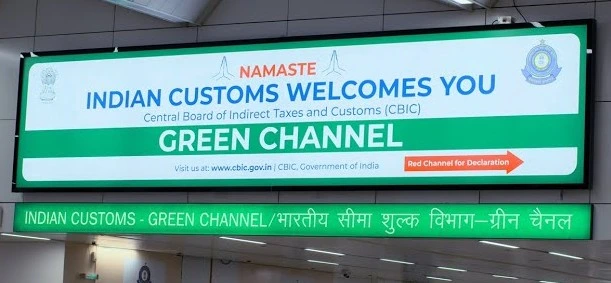
🟥 Red Channel is mandatory if you're carrying anything requiring declaration: goods above your duty-free value limit, currency above the threshold, gold or jewellery beyond the personal allowance, or any restricted item.
Choosing Green Channel when you should have gone Red is not a grey area.
If customs officers find undeclared dutiable or prohibited goods in your baggage after you've walked through Green Channel, it is treated as non-bona fide baggage under the Customs Act, 1962, with consequences well beyond simply paying the duty you owed.
Currency: What You Can Carry and When You Must Declare It
As a foreign national arriving on an India e-Visa, you may carry any amount of foreign currency into India. Declaration becomes mandatory in two specific situations:
- Foreign currency notes exceed USD $5,000 (or equivalent in any currency)
- Total foreign exchange: currency notes, bank notes, and traveler's cheques combined, exceeds USD $10,000 (or equivalent)
Amounts below both thresholds require no declaration at all. If you're above either threshold, declare it on the Customs Declaration Form at the Red Channel.
Indian currency (rupees) works differently: import of Indian currency into India is generally prohibited for foreign nationals. This specific allowance is for Indian residents returning from abroad, not for foreign India e-Visa holders. As a foreign traveler, don't attempt to bring rupees into India from outside the country; exchange currency after arrival instead.
Gold and Jewellery: Where India e-Visa Holders Most Commonly Get This Wrong
This is the area with the most confusion among foreign travelers, largely because the generous gold import allowances that circulate online apply to Indian passport holders and eligible Persons of Indian Origin; not to standard foreign India e-Visa holders.
❗Under current CBIC rules (Notification No. 45/2025-Customs), an eligible passenger of Indian origin or a passenger holding a valid Indian passport may import gold, subject to conditions including having resided abroad for at least six months and paying duty in convertible foreign currency (up to one kilogram of gold per eligible passenger).
❗If you're travelling to India on a standard India e-Visa as a foreign national with no Indian passport or OCI-linked eligibility, this generous allowance does not apply to you. Gold and silver in your baggage can only be brought in as personal ornamental jewellery within your general duty-free value limit, not as bullion, coins, or investment-grade gold.
One specific and useful exception: If you're bringing jewellery temporarily for a wedding or event in India and taking it back with you, this can be permitted based on a Temporary Baggage Import Certificate, obtainable from Customs on arrival. If this applies to your trip, be prepared to declare the jewellery and request this certificate at the Red Channel rather than attempting to bring it through the Green Channel.
Prohibited and Restricted Items: What You Genuinely Cannot Bring
❗Drones: Import of foreign drones is officially banned in India, with exceptions only for research, military, and security use. Nano drones under 250g (such as the DJI Mini series) sit in a genuine grey area in practice — some travelers pass through customs with them, others have had them confiscated, with no guaranteed outcome either way. If you travel with any drone, declare it at the Red Channel rather than risk Green Channel confiscation. For any drone above nano category, assume confiscation is likely without prior clearance from India's Directorate General of Civil Aviation (DGCA).
❗Satellite phones: Prohibited for import by foreign travelers entirely. Possession of a satellite phone (Iridium, Thuraya, or similar) in India without a license from the Department of Telecommunications is a criminal offence — not simply a customs violation.
❗Flat-panel televisions: LED, LCD, and Plasma TVs are explicitly excluded from the duty-free allowance regardless of value, and must be separately declared.
❗Meat, dairy, and agricultural products: Fresh meat, meat products, fish, dairy, seeds, plants, fruits, flowers, and other planting material all require declaration and are subject to biosecurity restrictions.
❗Commercial quantities of anything: The CBIC guide is explicit, only used personal effects required for satisfying daily necessities of life qualify for duty-free clearance. Goods in commercial quantities are not permitted as bona fide passenger baggage even if you're willing to pay duty on them. Bringing items in bulk for resale, gifting to a large group, or business purposes, is treated as non-bona fide baggage entirely differently from personal travel items.
The Digital Declaration Option
CBIC's guide confirms that digital baggage declaration is now widely accepted many Indian airports accept declarations through the Atithi app or the ICEGATE portal, in addition to the paper Customs Declaration Form (CBD-I). If you know in advance that you're carrying anything requiring declaration: excess currency, gold beyond personal allowance, or items above your duty-free value, completing this digitally before arrival can meaningfully speed up your time at the Red Channel.
Download the current CBD-I form from the official CBIC website or your specific arrival airport's customs portal ahead of travel if you prefer to have it ready rather than filling it out on arrival.
Where India e-Visa Holders Actually Land | Customs at Major Indian Entry Points
The customs rules above apply uniformly across India regardless of your port of entry but the practical experience differs by airport, since your India e-Visa is only valid for entry through authorized airports, seaports, and land ports. Most India e-Visa holders arrive through one of these major gateways:
Delhi (Indira Gandhi International Airport): India's busiest international gateway and the most common first entry point for India e-Visa holders. Both Green and Red Channel facilities are well staffed, though wait times during peak season (October–February) can be longer due to volume.
Mumbai (Chhatrapati Shivaji Maharaj International Airport): the second major entry point, particularly for travelers connecting onward to Goa or South India.
Bengaluru, Chennai, Hyderabad, Kolkata, and Kochi: All designated India e-Visa airports with standard customs processing, generally with shorter queues than Delhi or Mumbai outside peak season.
Want to know how the immigration process is done at Bengaluru airport? IVC Visas navigates India e-visa holders throughout the journey - from getting their ETA to landing safely in the city.
Goa (Dabolim and Mopa): A common arrival point given tourist volume, where customs officers are particularly familiar with typical e-Visa traveler baggage patterns.
Regardless of which of these you land in, the CBIC rules above apply identically, there is no city-specific variation in duty-free allowance or prohibited items.
Practical Tips for India e-Visa Travelers Before You Fly
✅ Know your allowance before you shop. If you're planning significant purchases during your India trip, like jewellery, electronics, or souvenirs in quantity, track the cumulative value against your ₹25,000 tourist allowance as you go, not after you've already exceeded it at the airport.
✅ Keep receipts for high-value items. If a customs officer questions the value of something in your bags, a receipt resolves the conversation quickly. Without one, you're relying on the officer's estimate.
✅ Don't test the Green Channel with anything uncertain. If you're unsure whether something needs declaring, like a piece of jewellery, an electronic device, or an amount of currency close to the threshold, declare it. The cost of over-declaring is a few extra minutes at the Red Channel. The cost of under-declaring and being caught is confiscation, penalties, and potential legal consequences under the Customs Act.
✅ Separate your e-Visa paperwork from your customs paperwork mentally. Your printed ETA, your e-Arrival Card confirmation, and your Customs Declaration Form are three different documents serving three different purposes. Have all three accessible, but don't assume completing one satisfies the requirement for another.
✅ If in doubt, ask at the Red Channel rather than guess at Green. Customs officers can advise you on borderline cases. This conversation is far better had voluntarily than triggered by a baggage search.
Your India e-Visa Is the First Document; Not the Only One
An approved India e-Visa is essential, but it's one piece of a broader arrival process that includes the e-Arrival Card, immigration clearance, and customs compliance. Getting the visa right is where most travelers focus their attention, and it's where a preventable, non-refundable fee mistake most commonly happens.
At IVC Visas, we review your India e-Visa application, photo, and documents before submission on both standard and express service, so that this part of your arrival is handled correctly from the start.
Start your India e-Visa application with enough lead time to also prepare properly for customs and the e-Arrival Card.
Why suffer through complications when IVC Visas' services exist?
We review your application, documents, and photograph before submission, ensuring everything is in order before a non-refundable fee is paid.
Contact our team if you have questions about your India e-Visa before you travel.
Disclaimer: IVC Visas is an independent visa service provider. We assist with application preparation and submission to official government portals related to India e-Visa applications. Final visa approval decisions are made solely by Indian immigration authorities. Customs rules and duty-free allowances are governed separately by India's Central Board of Indirect Taxes and Customs (CBIC) and may change; always verify current allowances via the official CBIC website before travel. All information is based on current regulations as prescribed by the Government of India, which may change. Always verify the latest requirements before travel.