India e-Tourist Visa: 30-Day, 1-Year, or 5-Year; Which One Is Right for You?

The India e-Tourist Visa is not a single product. It comes in three variants: 30 days, 1 year, and 5 years, each with different validity rules, entry allowances, and application windows. Most travelers from Ireland, South Korea, Austria and other eligible nations pick one based on price or assumed flexibility. Many get it wrong.
The 30-day and longer variants differ not only in their duration but also in when they start, the number of entries allowed, and what the stay limit actually means. Those distinctions matter more than the price difference, and they're rarely explained accurately.
IVC Visas here! We cover every confirmed detail from the official Indian e-Visa portal, no assumptions, no estimates; so you can choose the right option before you apply.
The 30-Day India e-Tourist Visa | Who It's Actually For?
⏳ Validity: 30 days from your first arrival date in India.
➜] Entries: Double.
The 30-day e-Tourist Visa is India's standard short-stay option. It is valid for 30 days from the moment you first arrive — not from the date of ETA grant, not from the date you apply.
If you land in Delhi on the 15th of the month, your visa expires on the 14th of the following month.
Double entry means you may exit India once and re-enter, provided both entries fall within the 30-day window. This is useful for travelers combining India with a neighbouring country such as Nepal or Sri Lanka on a single trip.
💻 Application window: You can apply a minimum of 4 days and a maximum of 30 days before your intended arrival. Unlike the longer variants, you cannot apply months in advance. Your application must be submitted within 30 days immediately before you travel.
🏷️ Best suited for: First-time visitors on a single trip, travelers with a fixed departure date and no plans to return within the year, and those who want to limit upfront cost.
🚨 One thing to be clear on: Although the 30-day visa is the lowest cost option, it offers the least flexibility. If your trip extends, you cannot extend the visa, and re-entering India after it expires requires a completely new application.
The 1-Year India e-Tourist Visa | What the 180-Day Rule Actually Means
⏳ Validity: 365 days from the date your ETA is granted.
➜] Entries: Multiple.
📅 Annual stay cap: Total stay in India must not exceed 180 days within any single calendar year.
The 1-year e-Tourist Visa is valid for one year, but it starts the clock from the day your ETA is issued, not the day you first travel. Apply in January and don't travel until August: you have lost seven months of your India visa's effective life. This is a critical distinction that many applicants overlook.
Within its 12-month window, it allows multiple entries into India. You can leave and re-enter as many times as you need; the only constraint is the 180-day annual cap.
What the 180-day cap actually means: You cannot spend more than 180 days inside India during any single calendar year, January to December. This is not a per-visit limit. There is no official restriction on how long a single continuous stay lasts, provided your total time in India within that calendar year does not breach 180 days. This cap applies per calendar year, not per visa year.
🏷️ Best suited for: Travelers making multiple trips to India within a year, splitting time between India and their home country, or those visiting for an extended period who may wish to exit temporarily and return.
The 5-Year India e-Tourist Visa | Flexibility With the Same Conditions
⏳ Validity: 5 years from the date your ETA is granted.
➜] Entries: Multiple.
📅 Annual stay cap: Total stay in India must not exceed 180 days within any single calendar year.
The 5-year e-Tourist Visa carries identical entry and stay conditions to the 1-year variant — multiple entries, the same 180-day annual cap — but extends the validity window to five years. Every other rule applies equally: it starts from the ETA grant date, it cannot be extended, and it cannot be converted.
The practical advantage is administrative ease across years. One application, one fee, five years of flexibility — without the need to reapply each time you plan a trip to India.
🏷️ Best suited for: Frequent India travelers, those with family or business connections in India who visit regularly, and travelers who want to visit India across multiple years without repeated applications.
Confirm your nationality, eligibility, and start your application with IVC when you're ready.
The Single Most Important Difference, And Why Most People Miss It
The 30-day visa starts on your arrival date.
The 1-year and 5-year visas start on your ETA grant date.
This has a practical consequence that is rarely explained clearly:
For the 30-day visa, the clock starts when you land. The time between application and travel doesn't affect your usable days in India.
For the 1-year and 5-year visas, the clock starts when the ETA is issued. If you apply in January and don't travel until April, three months of your visa's validity have already elapsed. For the 1-year visa in particular, applying too far in advance of your actual travel window reduces effective usability.
The practical implication: For the 1-year visa, apply within a few weeks of your intended first trip to India, not months in advance. For the 5-year visa, the impact of early application is smaller relative to the total validity, but still worth factoring in.
The 180-Day Rule | Common Misconceptions
🚫 Misconception 1: "I can stay 180 days in one stretch."
The 180-day cap is an annual calendar year limit from January to December; not permitted for a single continuous stay of 180 days. The official portal does not state a per-visit stay limit for the 1-year or 5-year tourist visa, but the calendar year total cannot exceed 180 days.
🚫 Misconception 2: "The 180-day limit resets when my visa year renews."
No. The cap is per calendar year (January 1 to December 31), not per visa year. If your India visa was granted in March and you spend 180 days in India between March and December, you cannot re-enter for tourist purposes until the following January, even though your visa remains technically valid.
🚫 Misconception 3: "If I have the 5-year visa, I can stay indefinitely."
No. The same 180-day annual cap applies to the 5-year visa. The longer visa duration does not modify the stay limit.
Conditions That Apply to All Three Variants
Regardless of which duration you choose, the following apply universally under the official portal's instructions:
- The India e-Tourist Visa covers recreation, sightseeing, casual visits, short-term yoga program, short-term courses in language, music, dance, cooking, or medicine not exceeding six months and not issuing a formal certificate or diploma, voluntary work not exceeding one month with no monetary compensation, and medical treatment, including treatment under Indian systems of medicine
- All three are non-extendable and non-convertible, once issued, the category and duration cannot be changed
- Passport must have at least 6 months' validity from the date of application, with at least 2 blank pages
- Each applicant must hold an individual ordinary passport — the visa is not available to individuals endorsed on a parent's or spouse's passport
- The e-Arrival Card must be completed within 72 hours before arrival via the official portal or the Indian Visa Su-Swagatam app; mandatory since April 2026
- Entry is only permitted through India's designated international airports, designated seaports, or the four designated land ports- Raxaul, Rupaidiha, Darranga, and Jogbani. Confirm your specific arrival point against the authorized entry and exit ports list before booking
- The processing fee is non-refundable once submitted, regardless of outcome.
Which One Should You Choose? A Quick Checklist!
The honest decision framework:
📌 Choose the 30-day visa if you are making a single trip with a fixed itinerary and no plans to return to India within the next 12 months. It is the lowest cost option and the most straightforward.
📌 Choose the 1-year visa if you plan to visit India more than once within a 12-month window or if your trip involves temporary exits to neighboring countries and re-entry. Apply within a few weeks of your first intended trip to maximize usable validity.
📌 Choose the 5-year visa if you visit India regularly across years- for family, travel, or personal reasons; and want to eliminate repeated applications. Calculate the cost across anticipated trips: for frequent travelers, the 5-year visa consistently represents better value per trip than annual reapplication.
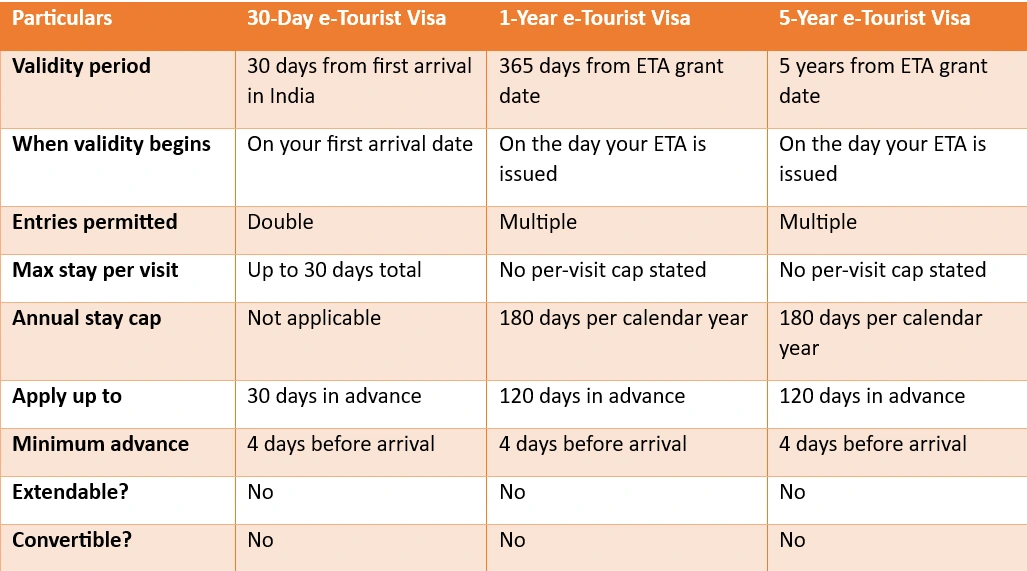
The Three Options at a Glance:
Unsure which category applies to your travel purpose, or want your application reviewed before a non-refundable fee is committed? At IVC Visas, our team reviews your category selection, documents, and photograph before submission, available on both standard and express .
Questions before you begin? Contact our team.
Disclaimer: IVC Visas is an independent visa service provider. We assist with application preparation and submission to official government portals. Final visa approval decisions are made solely by Indian immigration authorities. All information is based on current regulations as prescribed by the Government of India, which may change. Always verify the latest requirements before travel.