If you've just applied for an Indian e-Visa, there's a good chance you're refreshing your inbox every hour waiting for one specific email. But when it finally lands, the document inside can be genuinely confusing the first time you see it. It's not a sticker in your passport, it's not a stamp, and it doesn't look like most other visas travelers are used to. It's a standalone PDF called an Electronic Travel Authorization, or ETA, and knowing what it's supposed to look like before you receive it makes it far easier to spot when something's actually wrong.
This guide walks through exactly what an approved India e-Visa contains, field by field, using the current design confirmed by India's e-Visa portal and the Bureau of Immigration. Whether you're applying as a German business traveler, a Singaporean tourist, or a South African visiting family, the document you receive follows the same structure.
First: What Exactly Is an ETA?
An ETA isn't your visa in the traditional sense; it's official government authorization confirming that your India e-Visa application has been approved, and that you're cleared to travel to India and receive your actual India e-Visa stamp on arrival, at immigration. The stamp itself goes into your physical passport only when an immigration officer processes you at the airport or land border; the ETA is what gets you to that counter in the first place.
You'll receive it as a PDF attachment by email, sent to the address you entered on your application. It's not a webpage, not a text message, and not something that appears automatically in an app; it lands in your inbox, and you're expected to download, print, and carry it. The rule applies to every eligible India e-visa applicant from South Africa, Benin, France or other nationalities.
What the Approved ETA Document Actually Shows
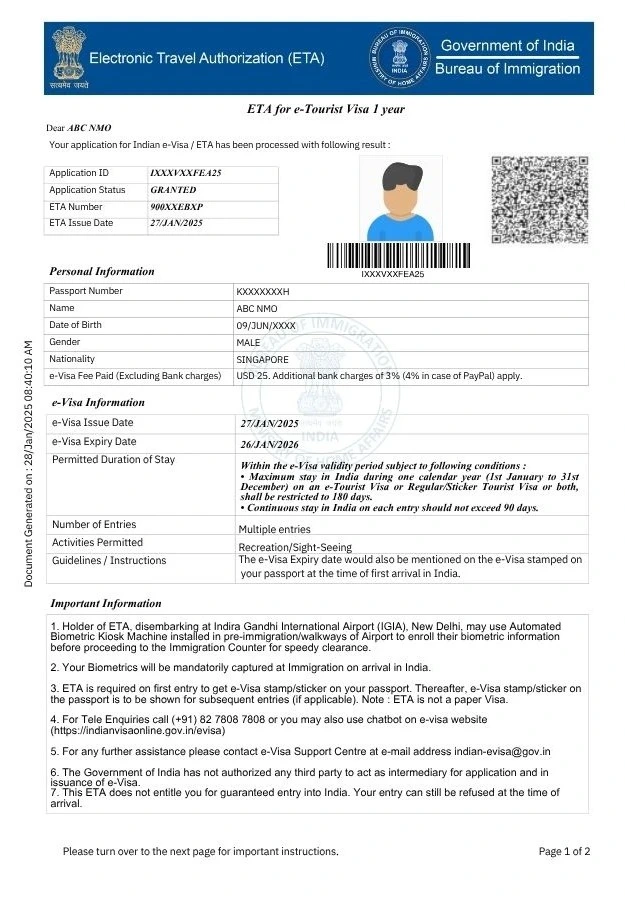
India redesigned its ETA format to make it easier for both travelers and immigration officers to read at a glance. Here's what you'll find on it, section by section.
1. The Visa Category and Type
Right at the top, the document states exactly what you applied for and what was granted, for example, "ETA for e-Tourist Visa (30 Days)" or "ETA for e-Business Visa." This matters more than it might seem: if you applied for a Business Visa but the document shows Tourist, or vice versa, that's a discrepancy worth catching before you fly, not after you land.
2. Application ID and ETA Number
These are two different reference numbers, and travelers frequently confuse them:
- Application ID: a 12-character alphanumeric code tied to your original application, used mainly for tracking and status checks before approval.
- ETA Number: the reference number on your approved document itself, this is what you'll typically be asked for if an issue comes up after approval.
Neither of these is labelled "Visa Number," a common point of confusion since most other countries' visas use that exact term. India's e-Visa system doesn't use that label at all, so if a form or an airline asks for your "visa number," your ETA number is generally the correct field to provide.
3. Application Status
You'll see the word "GRANTED" clearly marked once your application is approved. This is the single most important word on the entire document; if your status shows anything else, or if this field is missing entirely, that ETA isn't valid for travel.
4. Your Personal Details
The document repeats the information you submitted during application:
- Full name, exactly as it appears on your passport
- Nationality
- Date of birth and gender
- Passport number, issue date, and expiry date
This section is worth checking carefully. A single mismatched letter in your name or an incorrect passport number can cause real problems at immigration, and it's far easier to catch and correct before departure than at the airport counter.
5. Validity Window and Entry Details
This section tells you three separate things, and they're easy to mix up:
- The date range for your first arrival: you must enter India within this window, not before or after it
- The total validity of your visa category: for example, 30 days, 1 year, or 5 years from the date of grant
- Number of entries permitted: single, double, or multiple, depending on your category
As of recent updates, the first-arrival window for the 30-day e-Tourist Visa has been extended to 120 days from the date your ETA is granted, giving travelers considerably more flexibility to plan around it than the shorter windows previously allowed.
6. India e-Visa Fee Paid
A summary of the government processing fee you paid during application appears here, matched to your visa category and nationality. This isn't your full payment receipt, just a confirmation entry showing the government fee was successfully processed.
Note that if you are applying through an Indian visa service provider like IVC Visas, you also pay a separate service fee. Not only that, a 3% bank transaction fee is charged and 4% in case of PayPal. Still confused? IVC explains the entire fees breakdown for your required Indian visa.
7. Photograph and QR Code
Your passport-style photo appears alongside a scannable QR code. This QR code is specifically for immigration officers to verify your ETA electronically at the checkpoint, it isn't for you to scan yourself, and it's one of the strongest indicators the document is genuine, since it's tied directly to government verification systems rather than something a fraudulent copy could easily replicate.
8. Guidelines and Instructions
Toward the bottom, the ETA includes standard usage notes: that the e-Visa is non-extendable and non-convertible, that it isn't valid for Protected, Restricted, or Cantonment areas without separate permission, and that biometric details will be captured at the immigration checkpoint on your first arrival. It also confirms that you must travel on the same passport used for the application, with narrow exceptions for recently renewed passports carried alongside the old one.
What an Approved ETA Should Never Be Missing
Before you close that email and file the PDF away, do a quick pass through these essentials:
✅ Status clearly shows "GRANTED," not "Pending" or "Under Review"
✅ Name, passport number, and date of birth match your passport exactly
✅ Visa category matches what you actually applied for
✅ The arrival date window covers your actual planned travel dates
✅ A visible QR code is present, along with your photo
✅ Entry count matches what you expected for your category
If any of these don't line up, it's far better to catch it now than at an immigration counter thousands of miles from home. Common mistakes on e-Visa applications, like a typo in a passport number or a mismatched date of birth, are exactly the kind of error that shows up clearly once you know what to actually check for on this document.
What to Do If Something Looks Wrong
If you spot a discrepancy on your approved ETA, whether it's your name, passport number, or nationality, don't board a flight hoping it'll sort itself out at the airport. The official government guidance is to raise a discrepancy directly with the e-Visa support centre before travel, since immigration officers work strictly from what's printed on the document in front of them, not from what you meant to submit. If you applied through a service provider, that's also the fastest route to a correction, since document accuracy checks are usually part of what a review service catches before submission in the first place, not just after.
Printing, Saving, and Carrying Your ETA
A few practical points that trip up first-time travelers:
✅ Print at least two physical copies: Most Indian immigration checkpoints still expect a printed document, not a phone screen, and some airlines won't issue a boarding pass without seeing one at check-in.
✅ Keep a digital backup, saved to your email, phone, and a cloud drive, in case a printed copy is lost or damaged mid-trip.
✅ Carry it for every entry: If your visa permits multiple entries, you'll need the same ETA document each time you re-enter India, not just on your first arrival.
✅ Match passports carefully: If your passport was renewed after your ETA was issued, you'll generally need to carry both the old and new passport together.
You can also check your application's progress at any point through Track Application, useful if you're waiting on approval and want to confirm where things stand before the ETA itself arrives.
Why This Document Deserves a Careful Look
An approved ETA feels like the finish line, and in one sense it is; the hard part of applying is over. But it's also the document an immigration officer will scrutinise the moment you land, at one of the country's many authorized entry and exit ports, and it's the only thing standing between a smooth arrival and an uncomfortable conversation at the counter.
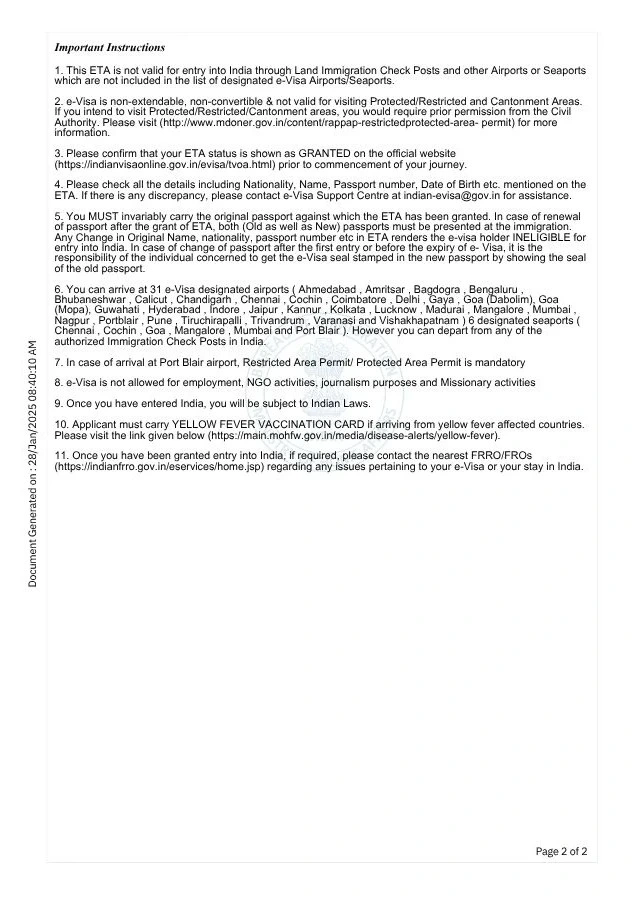
Reading it properly the day it arrives, rather than the night before your flight, gives you time to fix a problem while fixing it is still simple. Other than that, it also lays down some important guidelines to follow on the second page of the ETA PDF. Make sure to read it at least once.
Getting It Right the First Time, with IVC Visas!
An ETA is only as accurate as the application behind it, and that's really where the real work happens.
At IVC Visas, every application gets a technical and compliance review before submission, checking exactly the details this article just walked through: name spelling, passport data, visa category, and travel dates, so that what lands in your inbox is something you can trust without a second-guessing read-through.
We're not the government; we're not a shortcut around it either; we're the extra set of eyes that catches a mismatched passport number before it becomes a problem at an immigration counter in a country you've never been to before. If you're applying soon and want that reviewed rather than hoped for, that's exactly where we come in.
✅ Standard and express service available
✅ Pre-submission review on every application
✅ 24/7 support via Chat, WhatsApp, and Email
✅ Application tracking from submission to ETA
✅ Transparent pricing, no hidden fees
India has been waiting. Your India e-Visa is the only step away!
Start your India e-Visa application with IVC →
Disclaimer: IVC Visas is an independent visa service provider. We assist with application preparation and submission to official government portals. Final visa approval decisions are made solely by Indian immigration authorities. All information is based on current regulations as prescribed by the Government of India, which may change. Always verify the latest requirements before travel.