
India e-Visa Land Border Entry: What's Allowed and What Isn't
For years, the answer to this question was simple: NO. India e-Visa holders could only enter through designated airports or seaports, land border entry was not permitted under any circumstances.
That changed in December 2025.
India has now authorized four specific land border crossings for India e-Visa entry, adding them to the official list of designated ports on the Indian Visa Online portal. This expansion in the official list has created confusion in a few minds, and IVC is here to resolve.
What this blog covers:
- The short, accurate answer to whether the India e-Visa land entry is allowed
- The four authorized land border crossings and where they are, and which country each one connects to
- Why confusion exists — including a specific contradiction on the official portal
- How land border rules differ for e-Visa holders vs regular visa holders
- What happens at a non-authorized crossing
- The exit rule, which is different from the entry rule
- E-Arrival Card at Land Border Crossings
- Who this, doesn't apply to
- Practical overland travel scenarios
- Expectations at the Physical Crossing
Is an Indian e-Visa land entry allowed?
Yes, India e-Visa holders can enter India through a land border, but only through four specifically designated land border crossings. Entry through any other land crossing is not permitted on an India e-Visa, regardless of how common or well-travelled that crossing may be.
India has numerous official Immigration Check Posts across its land borders with Nepal, Bhutan, Bangladesh, Myanmar, Pakistan, and China. Of all of them, only four currently accept India e-Visa entry. All other land crossings require a regular sticker visa issued by an Indian Mission before travel.
The Four Authorized Land Ports for India e-Visa Entry
All four were added to the official India e-Visa portal between November 2024 and early 2026, making this a very recent development:
1. Raxaul - Bihar, India / Birganj, Nepal
One of the busiest India-Nepal border crossings. Raxaul connects directly with Birganj on the Nepali side and serves as a major transit point between Kathmandu and the Indian plains. Added to the e-Visa authorized list in December 2025.
2. Rupaidiha - Uttar Pradesh, India / Nautanwa (Bhairahawa), Nepal
Located in Uttar Pradesh, Rupaidiha connects with the Bhairahawa area on the Nepali side, near Lumbini, the birthplace of the Buddha. Particularly relevant for travelers combining religious or heritage sites in Nepal with onward travel into India. Added in January 2026.
3. Jogbani - Bihar, India / Biratnagar, Nepal
Situated in Bihar, Jogbani connects with Biratnagar, one of Nepal's major economic centers. It serves as a gateway to the Terai plains and is used frequently by travelers heading toward eastern India. Confirmed on the official portal in 2026.
4. Darranga - Assam, India / Samdrup Jongkhar, Bhutan
The only land port connecting to Bhutan rather than Nepal. Located in Assam's Tamulpur district, Darranga was formally designated as an authorized Immigration Check Post by the Ministry of Home Affairs in November 2024 and inaugurated on November 7, 2024. It is the first crossing to allow third-country nationals to enter India from Bhutan by land. Confirmed for e-Visa entry on the official portal subsequently.
Eligible nationals from Mexico, Finland, Poland and many more can apply with IVC Visas for a smooth India e-visa application.
Which source is authoritative?
The Entry Points section of India e-visa portal reflects the current, operative list of designated crossings. Though, the FAQs simply have not been updated to reflect the land port additions made between December 2025 and early 2026.
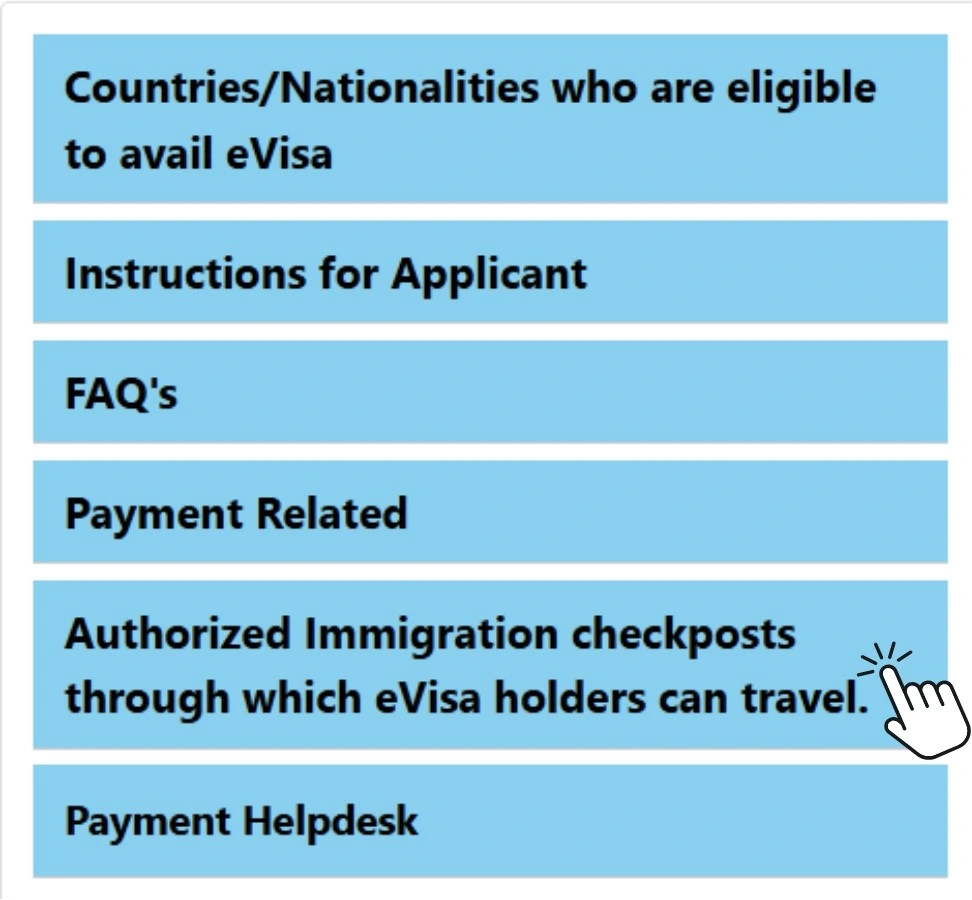
If you are making a travel decision based on this topic, use the Entry Points section as your reference. And always check the authorised India entry and exit ports list directly before confirming any overland itinerary, as the list has been actively expanding.
How This Differs for Regular Visa Holders
Travelers holding a regular India sticker visa, issued by an Indian Mission before travel, are not restricted to the four e-Visa land ports. Regular visa holders may enter through any of India's officially designated Immigration Check Posts across all land borders, subject to that specific ICP being open to foreign nationals.
This means travelers who plan an overland route through a crossing not on the India e-Visa list, for example, the popular Attari/Wagah crossing on the India-Pakistan border, or Moreh on the India-Myanmar border, or Dawki on the India-Bangladesh border, must hold a regular India sticker visa, not an India e-Visa.
If your overland route requires a crossing outside the four authorized India e-Visa land ports, apply for a regular India visa through the nearest Indian Embassy or High Commission before travelling.
What Happens If You Attempt Entry at a Non-Authorized Crossing
Entry will be denied. An India e-Visa holder who presents themselves at a land crossing not on the designated list, even a fully official Indian Immigration Check Post, will not be admitted on that India e-Visa. Immigration officers at non-authorized crossings do not have the authority to accept India e-Visa entry, regardless of the visa's validity.
This is not a technicality that can be argued at the border. It is a fixed entry condition. The consequences:
🚩 Immediate Rejection: You will not be allowed to clear immigration or cross into the country.
🚩 Deportation: You may be detained and put on the next available flight back to your origin.
🚩 No Visa Conversion: You cannot apply for a visa on arrival or convert your ETA to another visa type at the border crossing.
🚩 Legal Penalties: Violating Indian immigration laws can lead to hefty fines, detainment, and potential long-term travel bans.
Your travel plans will be disrupted accordingly. Plan your overland route against the authorized list before booking transport.
The Exit Rule; Which ports to exit from?
Entry and exit rules for India e-Visa holders are not the same.
Entry is restricted to authorized designated crossings, the airports, seaports, and four land ports listed on the official portal.
Exit is unrestricted. You may leave India from any authorized Immigration Check Post in the country, not limited to the specific type of crossing you entered through, and not limited to the four designated India e-Visa land ports.
This means you can enter India by air at Delhi airport and exit by land at Raxaul, or enter at Darranga from Bhutan and exit by air from Kolkata. The asymmetry is deliberate and confirmed on the official portal:
"Foreign nationals can exit India from any authorized ICP."
Does the e-Arrival Card Apply at Land Border Crossings Too?
Yes. Since April 1, 2026, the digital e-Arrival Card is mandatory for every foreign national entering India, and this applies regardless of whether you arrive by air, sea, or one of the four authorized land ports. There is no land-border exception.
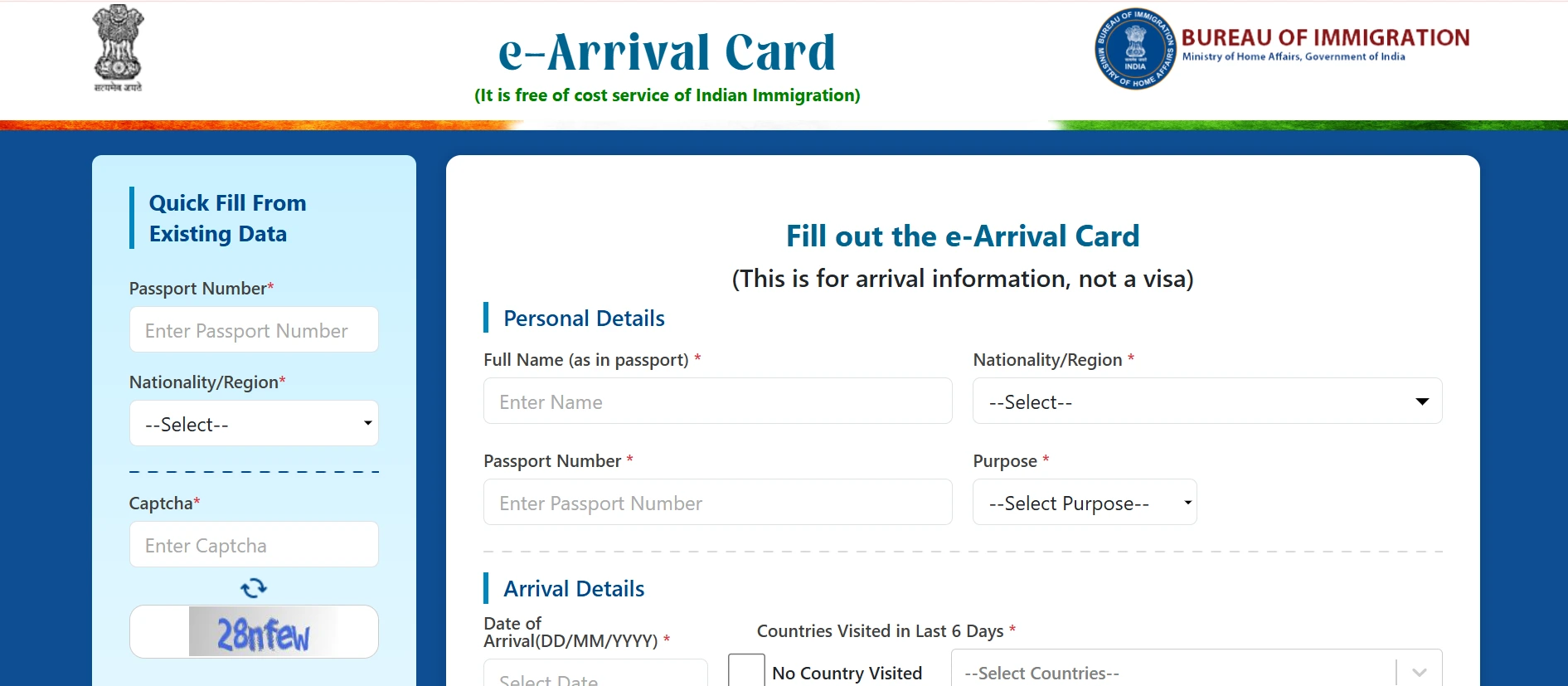
Practically, this means a traveler crossing at Raxaul or Darranga has exactly the same pre-arrival obligation as someone flying into Delhi: the e-Arrival Card must be completed online, through the official Indian Visa Online portal or the Indian Visa Su-Swagatam app, within 72 hours before arrival. It cannot be completed at the crossing itself, so travelers heading overland from Kathmandu, Biratnagar, or Samdrup Jongkhar need to plan for internet access and a little extra time before they reach the border, not after.
This is worth flagging because land border crossings are, by nature, less predictable than airports. Connectivity near some of these posts can be inconsistent, and unlike an airline check-in counter, there's no one prompting you to complete the form before you travel. Submitting it a day or two in advance, while you still have reliable internet, removes one more variable from an already less-standardized entry process.
Who These Rules Don't Apply To?
Two important groups for whom land border rules work differently:
1. Nepali and Bhutanese nationals are exempt from India's visa requirement entirely under bilateral arrangements. They do not need an India e-Visa or any visa to enter India. The India e-Visa land port restrictions simply don't apply to them.
But if a Nepali or Bhutanese national attempts to enter India from a third country, they must carry a valid passport with them.
2. OCI cardholders, regardless of which country's passport they carry, are also exempt from the India visa requirement. An OCI cardholder may enter India from any authorized Immigration Check Post without being restricted to the four India e-Visa land ports.
Practical Overland Travel Scenarios
Scenario 1 | Overland from Kathmandu to India
The most common overland route. crossing from Nepal into India can use Raxaul (connecting to Birganj), Rupaidiha (connecting to Bhairahawa), or Jogbani (connecting to Biratnagar) on an India e-Visa. All three are now authorized.
Confirm your approved India e-Tourist Visa or e-Business Visa is valid before attempting the crossing.
Scenario 2 | Entering India from Bhutan overland
Travelers arriving from Bhutan via Samdrup Jongkhar can now cross at Darranga on an India e-Visa. This is the only authorized e-Visa crossing on the India-Bhutan border.
Scenario 3 | Crossing at Wagah/Attari from Pakistan
Wagah/Attari is not on the e-Visa authorized land port list. Entry through this crossing requires a regular India sticker visa. An India e-Visa will not be accepted at this border.
Scenario 4 | Crossing from Bangladesh, Myanmar, or China
No land border crossing with Bangladesh, Myanmar, or China is currently authorized for India e-Visa entry. A regular India visa is required for any land crossing at these borders.
What to Expect at the Physical Crossing?
Land border entry works differently from arriving at an airport in a few practical ways that are worth planning around.
✅ Biometrics and immigration processing are still required.
Entering through Raxaul, Rupaidiha, Jogbani, or Darranga does not simplify or skip any part of the immigration process. Fingerprints and a photograph are captured at the Immigration Check Post exactly as they would be at an international airport, and your passport and e-Visa are verified against the same systems.
✅ These crossings are not all staffed around the clock.
Unlike a 24/7 international airport, land Immigration Check Posts typically operate within set daily hours, and those hours can vary by season or local circumstance. If you're planning an overland arrival, especially one timed around a bus or shared-jeep connection from Kathmandu, Birgunj, Biratnagar, or Samdrup Jongkhar, confirm the current operating hours for your specific crossing before finalizing your travel plans, since arriving outside operating hours can mean a wait until the post reopens.
✅ The crossing itself usually involves two separate checkpoints.
At each of these four locations, you'll clear an exit formality on the neighboring country's side (Nepali or Bhutanese immigration) before walking, or taking a short local transfer, across to the Indian side for entry processing. Keep both sets of travel documents accessible and don't assume the two sides move at the same pace; queues can be longer on one side than the other depending on the time of day.
✅ Currency and onward transport are handled locally.
None of the four crossings issue visas on the spot; your e-Visa must already be approved before you arrive. Once through, onward transport, buses, shared taxis, or private cars toward Patna (from Raxaul), Lucknow (from Rupaidiha), or Guwahati (from Darranga), is arranged locally rather than pre-booked internationally in most cases, so building in a buffer for that leg of the journey is worth doing, particularly if you're connecting onward the same day.
Treat a land crossing the way you'd treat a smaller regional airport rather than a major international hub: fully valid and fully official, but with less redundancy if something runs behind schedule. The paperwork requirements are identical to flying in; the margin for error in timing is simply tighter.
Unsure whether your specific overland route qualifies for an India e-Visa?
Check your eligibility first, verify your crossing against the authorized ports list, and apply through IVC Visas on standard or express service. Our team reviews your application, category, and documents before submission.
Start your India e-Visa application →
Contact our team in case of any queries. IVC has got your back!
Disclaimer: IVC Visas is an independent visa service provider. We assist with application preparation and submission to official government portals. Final visa approval decisions are made solely by Indian immigration authorities. All information is based on current regulations as prescribed by the Government of India, which may change. Always verify the latest requirements before travel.