India's e-Visa has been one of the government's most actively updated systems over the past two years. Between September 2025 and June 2026, a new immigration law came into force, new visa categories were added, a mandatory digital form for all arriving travelers was introduced, and a key registration rule was revised, all within a matter of months.
If you applied for an India e-Visa in 2023 or 2024, some of the rules have changed.

If you're applying for the first time in 2026, IVC Visas can be your starting point!
We explain every official update, sourced from the Ministry of Home Affairs, the Bureau of Immigration, and the official Indian e-Visa portal.
The Foundation - India's New Immigration Law
Every update in this guide sits within a larger framework: the Immigration and Foreigners Act 2025, which came into effect on September 1, 2025, restructuring India's immigration laws by consolidating four older acts into a single unified system. The new law imposes stricter penalties for immigration violations, strengthens the reporting and monitoring of foreign nationals, and mandates biometric data collection of foreign nationals upon arrival.
What changed under the new Act:
- Stricter penalties for immigration violations. Illegal entry now carries imprisonment of up to five years, a fine of up to five lakh rupees, or both. Forged travel documents carry up to seven years' imprisonment. Visa overstays trigger automatic penalties, and repeat offenders risk long-term or permanent blacklisting.
- Mandatory biometric data collection. The Act provides explicit legal mandate for collecting fingerprints, iris scans, and facial recognition data from all foreign nationals upon arrival — a practice previously restricted to select visa categories. This is now universal.
- Statutory Bureau of Immigration. The Bureau of Immigration (BoI), which previously operated under executive orders, has been granted statutory status under Section 5 of the new Act. It now manages a centralized national database of all foreign nationals in India, coordinates with state-level authorities, and provides policy guidance on visa and border control.
- Mandatory reporting obligations extended. Hotels, universities, hospitals, nursing homes, and other institutions hosting foreign nationals are now legally required to report relevant information to the Bureau of Immigration. Airlines and sea carriers must submit passenger and crew details to the BoI within 15 minutes of departure.
- Integrated Immigration Management System (IIMS). The new Act introduced a unified digital platform — IIMS, which is replacing the older IVFRT (Immigration, Visa and Foreigners' Registration and Tracking) system. The IIMS uses biometric identification and real-time data integration to track foreign nationals across airports, land border checkpoints, and registration offices.
Citizens from over 170 eligible countries, including USA, Netherlands, and Brazil continue to be eligible for India's e-Visa system. Confirm your eligibility with IVC Visas before starting an India e-visa application and plan your first trip to India with ease!
Let's go through the updates, so you are not left behind!
Update 1 - The e-Arrival Card Is Now Mandatory
The most immediate change affecting every international traveler to India in 2026, and the one with the most visible on-the-ground impact.
Since April 1, 2026, all foreign nationals and OCI cardholders are required to complete a digital e-Arrival Card before arriving in India. Paper disembarkation cards (the blue forms flight attendants handed out on aircraft for decades) have been phased out entirely and are no longer accepted.
A note on the timeline: OCI cardholders were required to submit the e-Arrival Card from October 1, 2025, three months ahead of the broader rollout. All other foreign nationals came under the requirement from April 1, 2026. Both groups are now subject to the same mandatory requirement permanently.
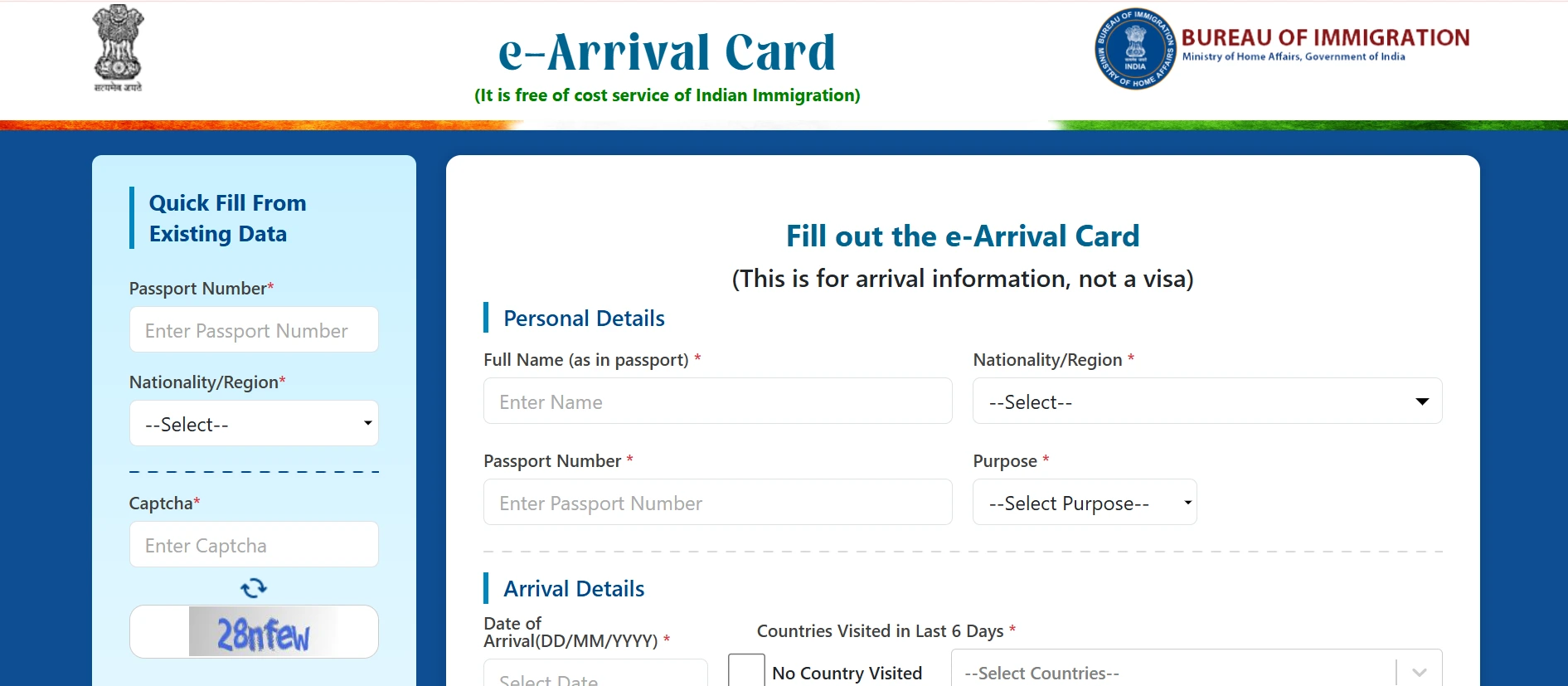
What the e-Arrival Card is:
It is an online pre-arrival declaration form that mirrors the information previously collected on the paper blue form: personal data, recent travel history, local contact details, and your address or accommodation in India.
The e-Arrival Card is not a visa.
It does not replace your India e-Visa ETA. Both are required; one does not substitute for the other.
How to complete it?
- Via the official India visa portal.
- Via the Indian Visa Su-Swagatam mobile app (available on iOS and Android, published by the National Informatics Centre, verify the publisher before downloading)
Free of charge through either official channel, no third-party agent or fee is required or valid
The 72-hour window:
The e-Arrival Card must be submitted within 72 hours before your scheduled arrival. no earlier, no later. Submissions made more than 72 hours in advance may be rejected by the system. The practical recommendation from regular travelers is to complete it 24–48 hours before your flight for the smoothest experience.
What happens after submission?
A QR code is generated and delivered to your email. Present it, either on your phone screen or as a printed copy, to the immigration officer at the e-Arrival counter on arrival. Officers scan the QR code alongside your passport for verification. Immigration processing times at major airports including Delhi and Mumbai have reportedly reduced by approximately 40% since the system went live.
What happens if you arrive without one?
You are directed to a staffed kiosk at the airport to complete the form manually. This causes delays, risks missing domestic connections, and should not be treated as a reliable fallback, particularly during peak season when immigration queues are already long.
Update 2 - Nine e-Visa Categories
India e-Tourist Visa:
Available in four sub-types — 30 days (double entry), 1 year (multiple entries, maximum 180 days in a calendar year), 5 years (multiple entries, maximum 180 days in a calendar year), and a mountaineering sub-type (e-T2V: 6 months, single entry, for designated trekking and mountaineering expeditions).
India e-Business Visa:
Valid 1 year from ETA grant, multiple entries, maximum 180 days per visit. Covers trade, commercial activity, and several specialist sub-types: conference attendance (e-B5V: 30 days, single entry), film production (e-B6V: 1 year, multiple entries), sports-related activity, academic lectures under GIAN, PLI/SPECS/EMC 2.0 scheme, and vessel joining.
India e-Medical Visa:
Valid 60 days from first arrival, triple entry. Now explicitly includes Ayush treatment (Ayurveda, Yoga, Naturopathy, Unani, Siddha, Homeopathy).
India e-Medical Attendant Visa:
Valid 60 days, triple entry. Maximum two attendants permitted per patient.
India e-Student Visa (new):
Valid 1 year, four entries. For admission to recognized Indian educational institutions. Previously handled through regular visa channels — now available through the e-Visa system.
India e-Family Visa (new):
Valid 1 year, four entries. For dependents of India e-Student Visa holders. Introduced to allow student visa holders to bring immediate family under the same streamlined system.
India e-Transit Visa (new):
Valid 30 days, double entry. For travelers transiting through India to a third country who need to exit the airport. Previously, transit situations were handled through regular visa channels or relied on the airside transit provisions.
India e-Miscellaneous Visa (new):
Valid 3 months, multiple entry. For persons of Indian origin with documented ties to India — covering situations that don't fall cleanly into tourist, business, or medical categories.
India e-Production Investment Visa (new):
Valid 6 months, multiple entries. For film production and investment activities, distinct from the e-B6V film production sub-type under the e-Business Visa.
The additions of e-Student, e-Family, e-Transit, e-Miscellaneous, and e-Production Investment Visa are all recent, introduced across 2025 to the online India e-Visa system. Applicants who previously had no option but regular visa channels for these purposes now have an online route available.
Update 3 - 30-Day e-Tourist Visa Now Applies Up to 120 Days in Advance
The 30-day India e-Tourist Visa previously had to be applied for within 30 days of the intended arrival date.
As of December 18, 2025, this application window has been extended to 120 days in advance, matching the window already available for the 1-year and 5-year e-tourist visas.
The minimum remains 4 days before arrival, but this floor is not a realistic plan. Real-world processing currently averages 8–10 business days regardless of the official 72-hour figure, and this extends further during the October–March peak season. The practical recommendation is to apply at least 2–3 weeks before travel regardless of which e-Tourist Visa duration you're applying for.
Apply well ahead of travel as real-world processing currently averages 8–10 business days regardless of the official 72-hour figure.
Update 4 - System-Generated Medical Invitation Letter (From April 2025)
For applicants using the India e-Medical Visa or e-Ayush Visa, a new document requirement has been in place since April 1, 2025: the Medical Invitation Letter is now system-generated through the official Indian government portal. The previously accepted hospital-issued letter is no longer sufficient on its own. This change applies to both India e-Medical and e-Ayush visa categories and must be factored into the application timeline.
Medical visa applicants should factor this into their planning timeline, particularly for time-sensitive treatments where the gap between booking and travel is short. Contacting the Indian hospital well in advance to confirm they've completed the portal-side process is now a necessary step before beginning the e-Medical Visa application.
Update 5 - FRRO Registration Rule Revised (June 2026)
Under the revised rules dated June 1, 2026, foreigners who enter India on a visa valid for 180 days or less and wish to remain beyond that period must now complete their registration before the expiry of the 180-day limit. Earlier, such individuals were allowed to register within 14 days after completing 180 days of stay in India.
If you intend to stay beyond 180 days on an India e-Business Visa or any other category that permits long stays, you must now initiate your FRRO registration at the FRRO portal before your 180-day period ends, not after. The revised provision also clarifies that permission for such extended stays will now be granted only in emergent circumstances.
For most India e-Tourist Visa who are subject to a 180-day calendar year cap rather than a continuous stay cap. Routine FRRO registration is not required unless circumstances change.
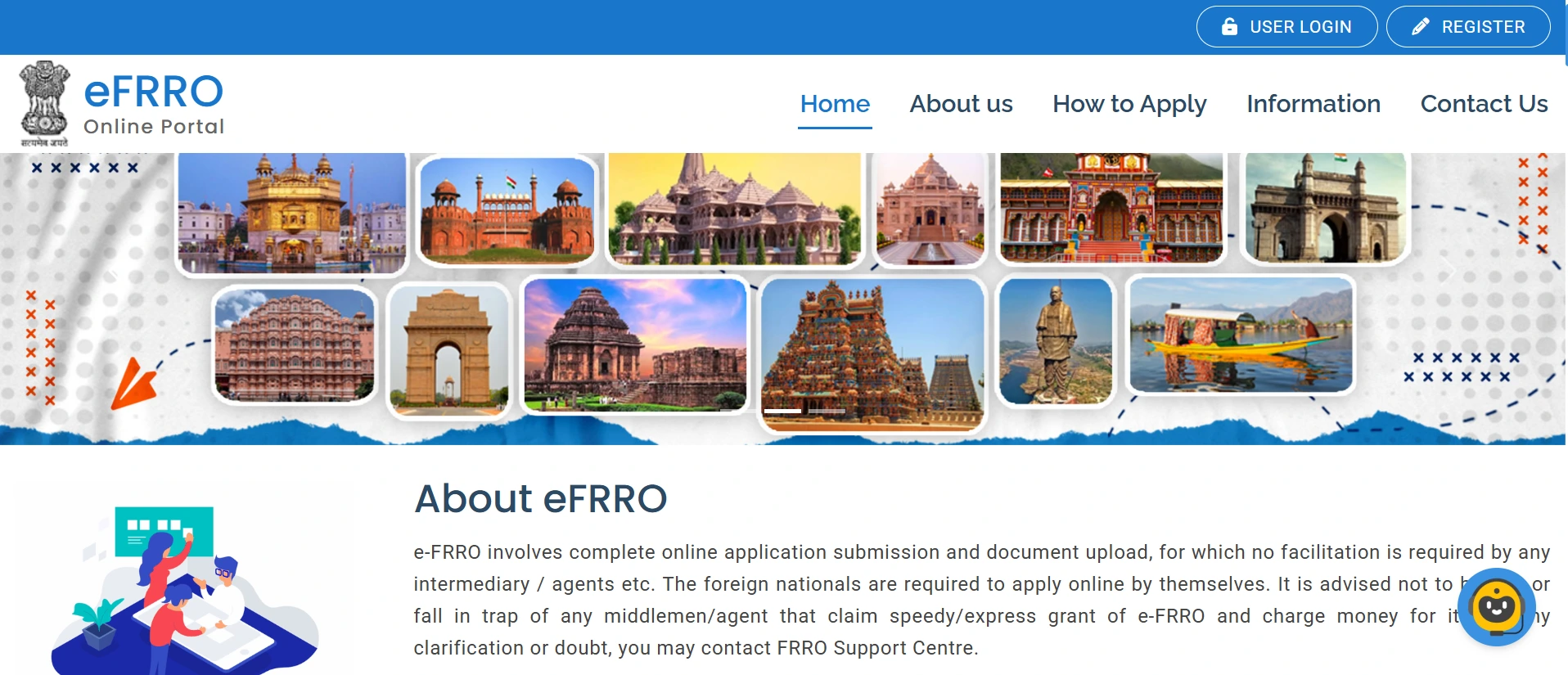
The practical implication: If you are traveling on an India e-Business Visa or any other category with a 180-day per-visit ceiling and you have any possibility of needing more time, initiate FRRO registration through the e-FRRO portal well before you reach the 180-day threshold. The 14-day window that used to provide a safety net no longer exists, and the consequences of missing the deadline — penalties, restricted future visa access, potential deportation proceedings — are now more immediate under the new Act's stricter enforcement framework.
Update 6 - Visa-on-Arrival (VoA) Conditions Confirmed
The Visa-on-Arrival facility remains available to three nationalities only: Japan, South Korea, and UAE. For stays up to 60 days for tourism, business, conference, and medical purposes.
For UAE nationals, VoA is available only to those who have previously held an India e-Visa or regular sticker visa.
All three nationalities may also apply for an India e-Visa through the standard online system. For first-time visitors from any of these three countries, the e-Visa route is the recommended approach regardless of VoA eligibility, since it provides a confirmed authorization before travel rather than relying on an on-arrival process.
Update 7 - Entry Points Expanded
The authorized entry points for India e-Visa holders now cover:
- 33 designated international airports
- 33 designated seaports
- 4 designated land ports: Raxaul, Rupaidiha, Darranga, and Jogbani
Check the full list for authorized India entry and exit ports page. Entry for India e-Visa holders is only permitted through these checkposts. Exit remains unrestricted; you may exit from any Immigration Check Post.
What Hasn't Changed?
Several fundamentals remain exactly as they were:
📌 Ordinary passport only. Diplomatic, official, and service passport holders are not eligible for an India e-Visa and must apply through the relevant Indian Mission.
📌 Passport validity: 6 months from arrival, 2 blank pages. No exceptions.
📌 All India e-Visas are non-extendable and non-convertible. The category and duration you apply for is the category and duration you travel on.
📌 The visa fee is non-refundable once submitted, regardless of outcome — approved or rejected.
📌 Bank transaction charges: 3% for card payments, 4% for PayPal, per the official government portal, inclusive of applicable taxes.
📌 Pakistani nationals and persons of Pakistani lineage (parent or grandparent born in or permanently resident in Pakistan) are not eligible for an India e-Visa.
📌 Biometrics are captured on arrival at all designated entry points — fingerprints, iris scans, and facial recognition — now with explicit legal backing under the new Act.
📌 The India e-Visa portal at indianvisaonline.gov.in is the only official application portal. No express lanes, emergency processing fees, or priority queues exist — any third-party site claiming otherwise is not operating legitimately.
Applying Through IVC Visas
Every update above affects what your application must contain and what you must do before you fly.
At IVC Visas, our team reviews your documents, photo, and application details against current requirements before submission, ensuring your India e-Visa application reflects the rules as they stand in 2026, not as they were in 2024.
Questions before applying? Contact our team directly.
IVC Visas can guide you 24x7, so you don't remain behind on your journey to India!
Disclaimer: IVC Visas is an independent visa service provider. We assist with application preparation and submission to official government portals. Final visa approval decisions are made solely by Indian immigration authorities. All information is based on current regulations as prescribed by the Government of India, which may change. Always verify the latest requirements before travel.