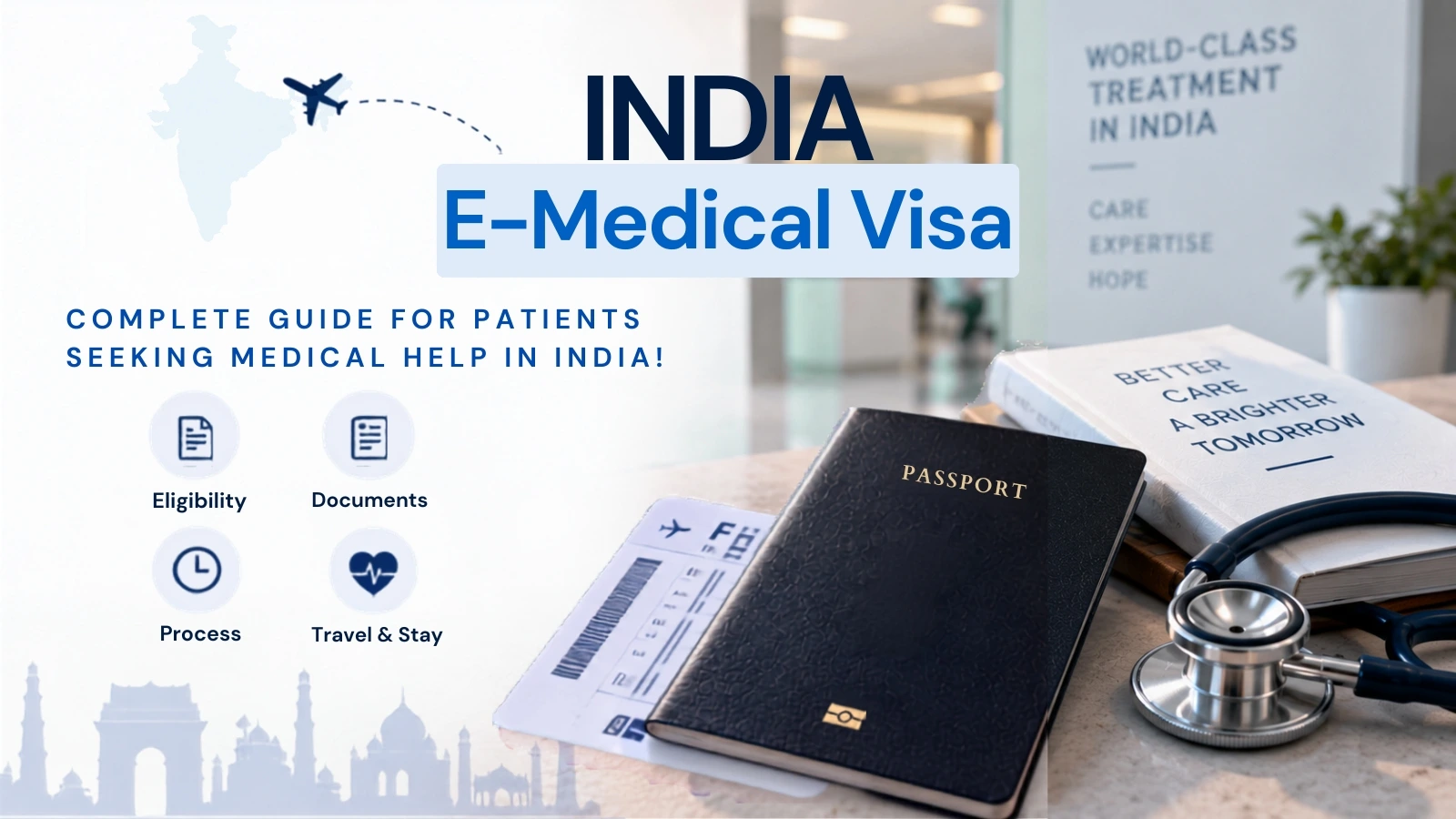
India has become one of the world's leading destinations for affordable, high-quality medical care, drawing patients from across the Middle East, Africa, Central Asia, and beyond for treatments ranging from cardiac surgery to organ transplantation at a fraction of the cost charged in the US, UK, or Gulf region.
The India e-Medical Visa exists specifically to make this possible, with a streamlined online process built around exactly this kind of travel.
But the e-Medical Visa has one step most guides either skip entirely or explain incorrectly; a requirement that starts with your hospital in India, not with you. Getting this wrong is the single most common reason medical visa applications stall. This guide covers the entire process accurately, from the hospital's side of the paperwork through to your arrival at Indian immigration.
What the India e-Medical Visa Actually Covers
The India e-Medical Visa is for foreign nationals travelling to India specifically for treatment at a recognized Indian hospital or treatment centre. This includes treatment under conventional (allopathic) medicine as well as India's traditional medicine systems: Ayurveda, Yoga, Naturopathy, Unani, Siddha, and Homeopathy, which fall under a related sub-category, the e-Ayush Visa, using the same underlying process.
India's medical tourism sector treats a wide range of conditions through this visa route, commonly including cardiac and cardiovascular procedures, neurosurgery, orthopaedic and joint replacement surgery, organ transplantation, oncology and radiotherapy, ophthalmic surgery, renal treatment, plastic and reconstructive surgery, and fertility treatment. This is not an exhaustive or official list; any genuine medical treatment at a recognised Indian hospital qualifies, and the specific condition doesn't need to fall into a predefined category.
✅️ Validity and entries: The India e-Medical Visa is valid for 60 days from your first arrival in India, with triple entry permitted within that window, allowing you to exit and re-enter up to three times, useful for treatment involving multiple visits, follow-up consultations, or a brief return home between procedure stages.
✅️ Companions: Family members or attendants accompanying the patient apply separately for the e-Medical Attendant Visa, not the e-Medical Visa itself. A maximum of two attendants are permitted per patient, and the attendant visa carries the identical 60-day, triple-entry validity as the patient's visa, running concurrently with it.
The Step Most Guides Get Wrong: The Hospital Must Act First
This is the part of the process that catches patients off guard, because it depends on action taken by your hospital in India before you can even complete your own application correctly.
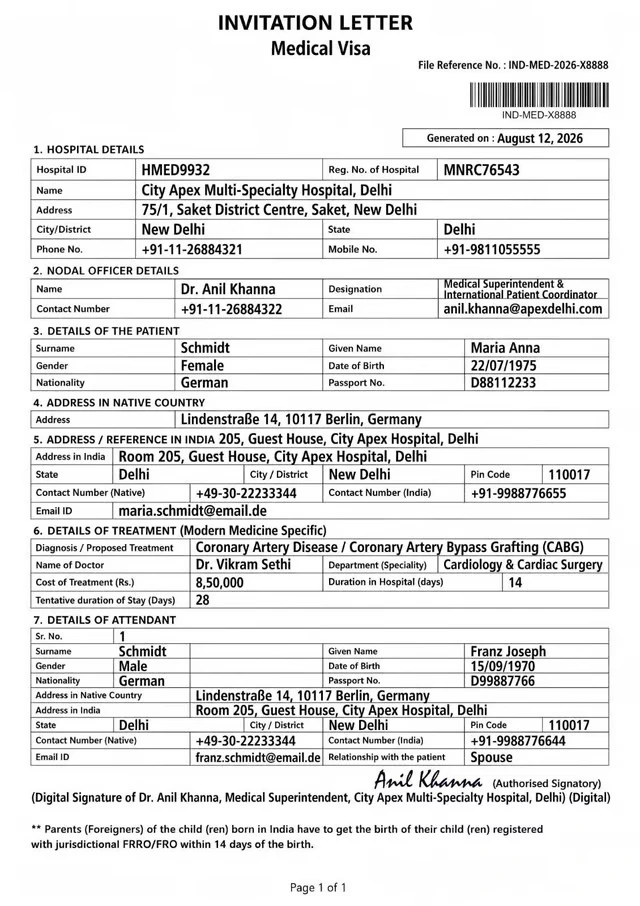
Per current government requirements, the Medical or Medical Attendant Visa invitation letter cannot be written on hospital letterhead and emailed to you. It must be generated through India's official Medical and Ayush Visa Portal, and before that, the treating hospital must be registered on that portal.
Here's exactly how the sequence works:
- The hospital registers on the Medical and Ayush Visa Portal (a government system distinct from the standard India e-Visa portal), if it isn't already registered.
- The hospital's registration is reviewed and approved by the relevant Foreigners Regional Registration Office (FRRO).
- Once approved, the hospital generates your invitation letter directly through the portal, specifying your name, nationality, passport number, the nature of your treatment, and the tentative date of admission.
- The hospital shares the resulting PDF invitation letter with you, which is a pre-validated document that you upload with your e-Medical Visa application, not a generic letterhead letter typed up independently.
What this means practically: Before you begin your own e-Medical Visa application, confirm with your chosen Indian hospital that they are registered on the Medical and Ayush Visa Portal and can generate this specific pre-validated letter. Most major hospital chains with established international patient departments- Apollo, Fortis, Max Healthcare, Manipal, and similar large networks — are already registered and handle this routinely. Smaller or less internationally-oriented hospitals may not be, and this can add unexpected delay if discovered late.
If your hospital cannot generate this letter, your e-Medical India Visa application cannot be properly completed: a standard letter on hospital letterhead, however official it looks, does not satisfy the current requirement on its own.
Documents You Need: The Complete List
From you, the patient:
- Valid ordinary passport with at least 6 months validity from your intended India arrival date, and at least 2 blank pages
- Scanned passport bio page: colour PDF, 10 KB–300 KB, all details clearly legible
- Recent passport photograph: JPEG, 10 KB–1 MB, plain white background, no glasses, taken within the last 6 months
- Proof of a return or onward travel ticket
- Proof of sufficient funds to cover your stay and treatment a recent bank statement, sponsorship letter, or insurance documentation is commonly requested
- Existing medical records, diagnostic reports, and referral documentation from your home country's doctor, where available; while not always mandatory on the India e-Visa portal itself, these strengthen your application and are frequently requested by the hospital to prepare your treatment plan in advance
From the hospital in India:
- The pre-validated invitation letter generated through the Medical and Ayush Visa Portal, specifying your name, nationality, passport number, the nature of treatment, and tentative admission date
For each accompanying attendant:
- Their own passport scan and photograph, meeting the same specifications as the patient's
- Proof of relationship to the patient; attendants are generally expected to be blood relatives or a spouse
All documents must be in English. A letter or medical record in any other language should be translated before submission.
Applying for the India e-Medical Visa | Step by Step
Step 1: Confirm your hospital and treatment plan first.
Before touching the visa application, have your treatment confirmed with a specific recognized Indian hospital, and confirm that the hospital can generate your pre-validated invitation letter through the Medical and Ayush Visa Portal.
Step 2: Receive the invitation letter PDF from the hospital.
This document is central to your application; do not proceed without it in hand.
Step 3: Complete the e-Medical Visa application through the official Indian government portal or through IVC Visas, which could be a better and more convenient option if you want a smoother India e-visa application.
Enter your personal and passport details exactly as they appear on your passport, select the e-Medical Visa category, and upload your documents, including the hospital's invitation letter.
Step 4: Apply for the e-Medical Attendant Visa separately for each accompanying family member, up to a maximum of two, submitting their own documents alongside proof of relationship to you.
Step 5: Pay the applicable fee.
Fees vary by nationality under India's reciprocal pricing model: a 3% bank transaction charge applies additionally on card payments (4% for PayPal). Check the current fee for your nationality before applying, either with IVC or through the official portal.
Step 6: Receive your ETA by email once approved, and confirm your status reads 'GRANTED' on the official portal before travelling.
Given the additional hospital-side step involved, build in more lead time than you would for a standard tourist visa, begin the hospital registration confirmation and invitation letter process at least 3–4 weeks before your intended treatment date, not the 2–3 weeks typically recommended for other categories.
What Happens Once You Arrive in India
📌 The e-Arrival Card is still mandatory; complete it within 72 hours before arrival via the official portal or the Indian Visa Su-Swagatam app, exactly as for any other India e-Visa category. This applies to attendants as well as the patient.
📌 Biometrics are captured on arrival, and your passport is stamped with your permitted duration of stay. Verify this stamp before leaving the immigration counter.
📌 If your treatment requires you to stay longer than 60 days, remember that the e-Medical Visa is non-extendable in the standard sense; but genuine medical circumstances requiring extended treatment are one of the specific situations where an application through indianfrro.gov.in before your visa's expiry may be considered, given the clearly justifiable medical reason. This is discretionary and requires supporting medical documentation from your treating hospital confirming ongoing necessity.
📌 If your treatment plan changes to a different hospital after arrival, or your diagnosis shifts significantly, this does not automatically invalidate your visa, but it's worth informing your original hospital and, where relevant, the FRRO, particularly if the change affects your expected treatment timeline.
Choosing the Right Hospital | What to Verify Before You Commit?
Since the invitation letter depends entirely on your hospital's registration status, verifying this early avoids the most common source of delay in the entire process. When researching hospitals for treatment in India, confirm directly with their international patient department:
- Whether they are registered on the Medical and Ayush Visa Portal
- Their typical turnaround time for generating the invitation letter once your treatment is confirmed
- Whether they have a dedicated international patient coordinator who can guide you through this specific requirement
Most large private hospital networks with established international patient volumes handle this as a routine part of their onboarding process: it's worth asking directly rather than assuming.
A Note on Family Members Not Accompanying You as Attendants
If a family member wishes to visit India during your treatment but isn't functioning as your medical attendant- for example, joining partway through your stay rather than travelling with you from the outset, or visiting primarily for other reasons- they should apply for the standard e-Tourist Visa rather than the e-Medical Attendant Visa, since that category is specifically tied to accompanying the patient as a caregiver.
Preparing for Treatment in India Shouldn't Mean Navigating Visa Bureaucracy Alone
Patients coming to India for treatment are already managing enough — a diagnosis, a treatment plan, often significant travel arranged around genuine medical need. The visa process shouldn't be the added source of stress it frequently becomes, particularly given the hospital-side portal requirement that trips up so many applicants who aren't told about it in advance.
Why choose IVC Visas?
At IVC Visas, we've built our e-Medical Visa process around exactly this problem — checking upfront whether your hospital's invitation letter meets the current portal requirements, reviewing every document before submission, and coordinating attendant visa applications alongside the patient's so nothing falls out of sync. If your treatment date is approaching quickly, our express service prioritises your application on our side while we help you resolve any hospital documentation gaps before they become a delay you feel at the worst possible moment.

You've already done the hard part, deciding to seek treatment and choosing where. Let us handle the paperwork so you can focus on getting better.
Start your e-Medical Visa application, or talk to our team first if you'd like help confirming your hospital's documentation is in order before you begin.
Disclaimer: IVC Visas is an independent visa service provider. We assist with application preparation and submission to official government portals. Final visa approval decisions are made solely by Indian immigration authorities. Medical treatment arrangements, hospital selection, and clinical decisions are between the patient and the treating hospital, and are outside the scope of IVC Visas' services. All information is based on current regulations as prescribed by the Government of India, which may change. Always verify the latest requirements before travel.