Some trips are built around beaches or monuments. This one is built around something harder to photograph but easier to feel. Varanasi, Rishikesh, and Amritsar sit in three different states, belong to three distinct spiritual traditions, and together form one of the most meaningful circuits a traveler can take through northern India. One is the oldest continuously inhabited spiritual city on earth. One became the world's yoga capital almost by accident. One holds the holiest site in Sikhism, where a kitchen has fed strangers for free, every day, for centuries.
This guide walks through all three, in the order most travelers actually visit them, along with the practical groundwork: the India e-Visa you'll need before any of this can happen at all.
The India e-Visa You'll Need Before This Trip
None of the sightseeing below matters if the paperwork isn't sorted first, so start here.
For a spiritual circuit like this, purely for personal travel, temple visits, ceremonies, and short yoga or meditation programs, the India e-Tourist Visa is the correct category. It covers exactly this kind of trip explicitly, including short-term yoga courses in Rishikesh under six months that don't result in a certification.
A few practical notes specific to this itinerary:
- Duration: A 30-day e-Tourist Visa comfortably covers a 10 to 14-day circuit across all three cities, though the 1-year multiple-entry option is worth considering if you think you might return to extend a yoga program or come back for a festival season.
- Entry point: Most travelers on this circuit fly into Delhi, since it sits roughly equidistant from all three destinations and has the widest range of international connections. Delhi is a fully designated e-Visa entry airport.
- Processing time: Apply at least 2 to 3 weeks before departure. The government's stated minimum is 4 days, but real-world processing regularly takes longer, and a spiritual trip with fixed ceremony timings, like a specific Aarti date, isn't the kind of plan you want to leave to the last minute.
Not sure which duration or category fits your specific itinerary? Applicants with Singapore, Finland, or other eligible nationalities can get in touch with our team before they apply, and we'll help you choose the first time correctly so it doesn't become the reason for your India e-visa rejection.
Varanasi: Where the Circuit Begins
Varanasi is not a place that eases you in. It's often the most intense stop on this entire trip, and most travelers who've done all three cities say it's the one that stays with them longest.
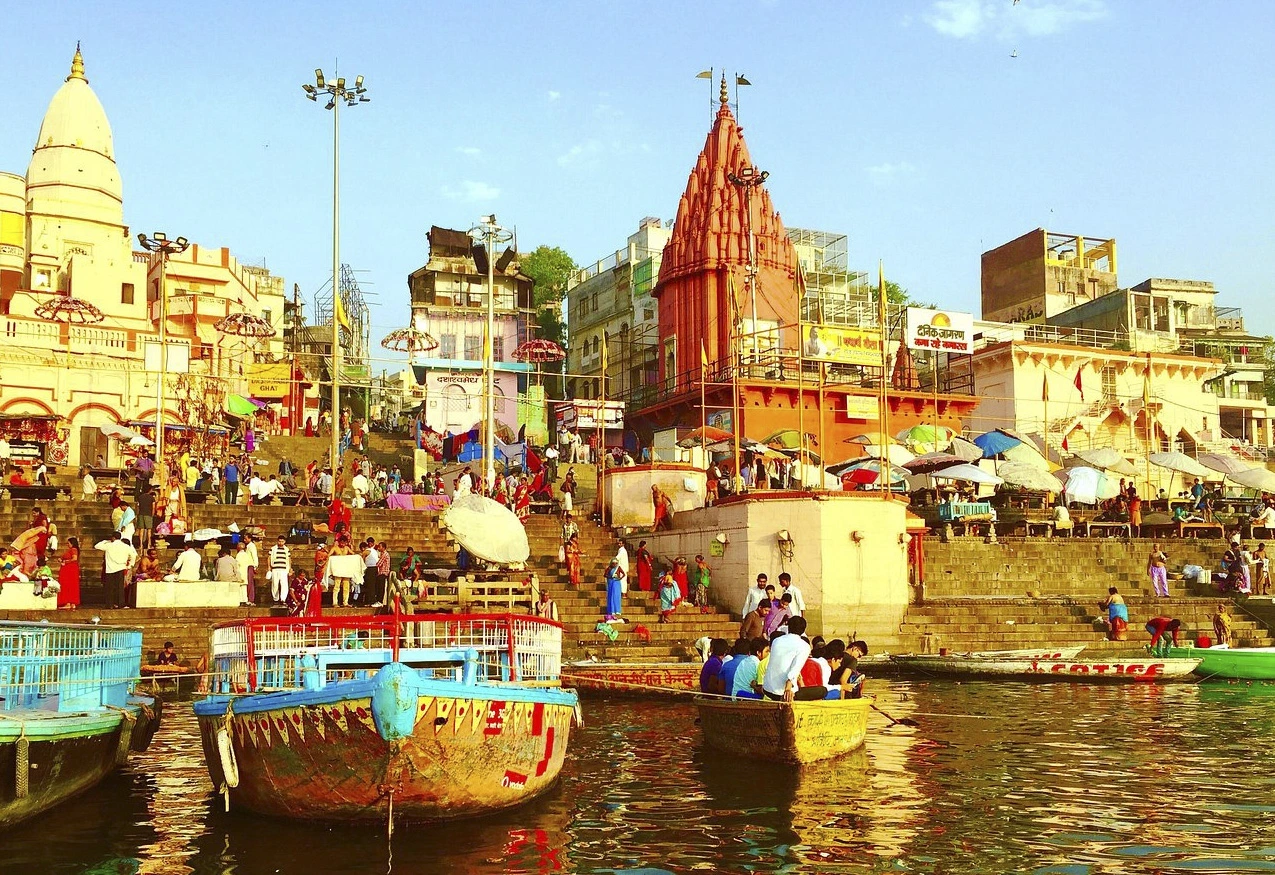
The city sits on the banks of the Ganges, and life along its ghats runs on a rhythm that has continued for thousands of years, largely unchanged by anything happening outside it. Cremation rites, morning prayers, boat traffic, and pilgrims bathing in the river all happen within view of each other, often within the same hour.
✅ What to actually do here:
- Watch the Ganga Aarti at Dashashwamedh Ghat, held every evening at sunset. Priests perform a synchronized fire ceremony facing the river, accompanied by chanting and music. Arrive at least 45 minutes early if you want a seated view rather than standing at the back of a large crowd.
- Take a sunrise boat ride on the Ganges. This is the version of Varanasi most photographs try to capture, and it's worth experiencing in person, ideally with a licensed boatman rather than an unregistered one approaching you on the ghat steps.
- Walk the old city lanes near the ghats, which are narrow, crowded, and genuinely disorienting on a first visit. This is normal. Most travelers find their bearings by day two.
- Visit the Kashi Vishwanath Temple, one of the most significant Shiva temples in India, located a short walk from the main ghats.
A cultural note worth knowing before you arrive: Cremation ceremonies happen in public view along certain ghats, and this can be a genuine shock for first-time visitors. Photography of cremation ceremonies is considered deeply disrespectful and is restricted in several areas. Observing quietly from a respectful distance, without a camera raised, is the appropriate response if you find yourself near one.
Rishikesh: The Himalayan Turn
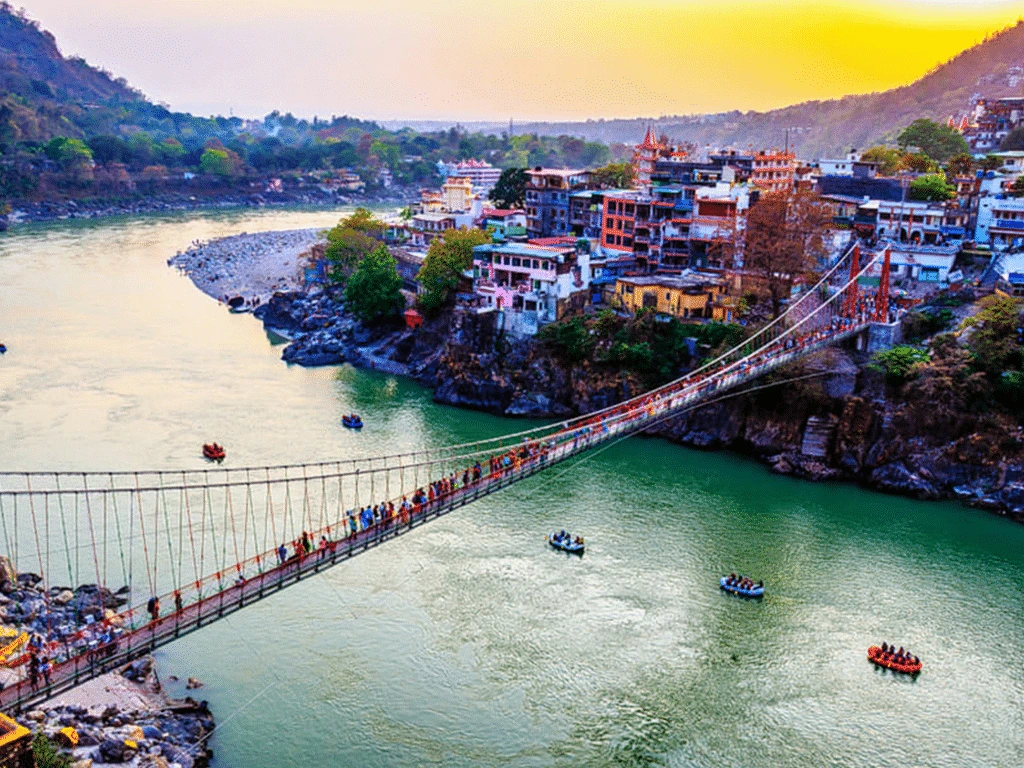
From Varanasi, most travelers head north toward Rishikesh, a shift in both geography and pace. The Ganges here is a different river entirely, clear and fast-moving, framed by the Himalayan foothills rather than the flat plains of Uttar Pradesh.
Rishikesh's reputation as the world's yoga capital isn't marketing. Yoga schools, ashrams, and meditation centers genuinely concentrate here more densely than almost anywhere else on earth, and the town's global profile grew significantly after the Beatles famously stayed at Maharishi Mahesh Yogi's ashram in 1968.
✅ What defines a Rishikesh visit:
- Attend the Ganga Aarti at Parmarth Niketan, one of the largest ashrams in Rishikesh, held every evening along the riverbank with hundreds of participants, chanting, and floating diyas released onto the water.
- Join a short yoga or meditation program, if your schedule allows. This is explicitly permitted under the e-Tourist Visa for programs under six months that don't result in a formal certification, making it one of the few places where the visa category and the activity align this directly.
- Cross the Lakshman Jhula or Ram Jhula suspension bridges, both iconic pedestrian bridges over the Ganges, connecting the town's two halves.
- Try white-water rafting, a popular half-day activity on the river's calmer upstream stretches, widely available through registered local operators.
Rishikesh rewards a slower pace more than either of the other two stops. A minimum of two full days is reasonable; travelers doing a dedicated yoga retreat often stay a week or more.
Amritsar: The Golden Temple
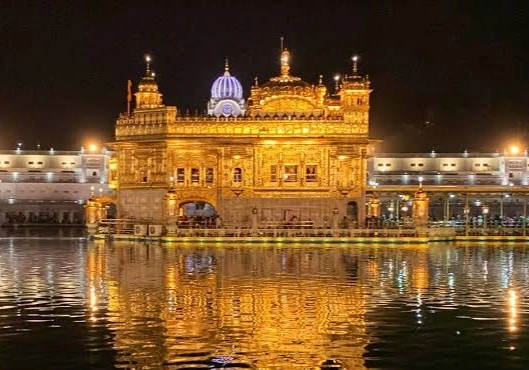
The final stop, and for many travelers, the most emotionally striking. Sri Harmandir Sahib, known globally as the Golden Temple, is the holiest site in Sikhism, and its atmosphere is unlike either Varanasi or Rishikesh: calm, orderly, and built around one of the most powerful expressions of hospitality found anywhere in the world.
✅ What to prioritize in Amritsar:
- Visit the Golden Temple at dawn, before the crowds build, to see the temple's gold dome reflected in the Amrit Sarovar, the sacred pool surrounding it.
- Eat at the Langar, the temple's free community kitchen, which serves simple vegetarian meals to every visitor, regardless of religion, background, or ability to pay, to upwards of 100,000 people daily. Sitting down to eat here, alongside pilgrims and locals, is widely considered one of the most moving experiences on the entire circuit.
- Attend the Palki ceremony, the nightly procession that carries the Guru Granth Sahib, Sikhism's holy scripture, from the sanctum to its resting place, accompanied by devotional music.
- Visit the Jallianwala Bagh memorial, a short walk from the temple complex, marking the site of the 1919 massacre and one of the most significant locations in India's independence history.
- See the Wagah Border ceremony, roughly 30 kilometers from Amritsar, a highly theatrical daily flag-lowering ceremony at the India-Pakistan border, drawing large, enthusiastic crowds on both sides.
✅ Etiquette at the Golden Temple, non-negotiable:
- Cover your head at all times inside the complex. Scarves are available at the entrance if you don't bring your own.
- Remove your shoes before entering, and walk through the water channel provided to wash your feet.
- No alcohol, tobacco, or leather items should be brought into the temple grounds.
- Dress modestly, covering shoulders and knees.
Getting Between the Three Cities
The distances here are real, and this is where flying and the train network both play a role, depending on your time budget.
Delhi functions as the natural hub. From Delhi, Amritsar is roughly 450 kilometers, comfortably covered by a fast train in around 6 hours, or a short domestic flight. Varanasi is best reached from Delhi by a short flight, since the overland distance and travel time by train run considerably longer. Rishikesh connects from Delhi via train to Haridwar in around 4 to 5 hours, followed by a short road transfer of about an hour.
The most common circuit sequencing looks like this:
Delhi → Varanasi (flight) → Delhi → Haridwar/Rishikesh (train + road) → Delhi → Amritsar (train or flight) → Delhi (departure)
This routes everything back through Delhi between stops rather than attempting a direct city-to-city overland journey, which for Varanasi to Rishikesh alone runs 750 to 800 kilometres by road, a genuinely long transfer better avoided on a time-limited trip.
✅ A Realistic 12-Day Itinerary
Days 1–2: Arrive in Delhi, rest, adjust.
Days 3–5: Fly to Varanasi. Ghats, Ganga Aarti, Kashi Vishwanath Temple, sunrise boat ride.
Day 6: Fly back to Delhi.
Days 7–9: Train to Haridwar, road to Rishikesh, Ganga Aarti at Parmarth Niketan, yoga session, rafting.
Day 10: Return to Delhi.
Days 11–12: Train or flight to Amritsar, Golden Temple at dawn, Langar, Palki ceremony, Wagah Border.
Travelers with more flexibility often extend the Rishikesh portion into a full week-long yoga program, since it's the stop most suited to slowing down entirely.
📅 When to Go?
October through March is the ideal window across all three cities. Varanasi and Amritsar both get uncomfortably hot from April onward, and Rishikesh's monsoon season, roughly June through September, can disrupt river activities and road access through the hills. Winter mornings in Varanasi and Amritsar can be surprisingly cold and foggy, so pack layers regardless of the season.
A Few Cultural Notes That Apply Across All Three Cities
📌 Dress modestly everywhere, not just inside temples. Shoulders and knees covered is a safe general rule across all three cities.
📌 Remove shoes before entering any temple or gurdwara, without exception.
📌 Ask before photographing people, particularly at ghats, inside religious sites, and around ceremonies.
📌 Carry small cash denominations. Many local vendors, boatmen, and smaller establishments across all three cities don't reliably accept cards.
📌 Move at the pace the city sets, especially in Varanasi's old lanes, rather than rushing between sights on a tight schedule.
Other than that, follow a quick checklist:
- Apply 4-7 days before departure (earlier during peak seasons).
- Verify 6-month passport validity from the date of arrival in India.
- Provide accurate, consistent information.
- Keep digital and printed copies of all documents.
- Complete the e-Arrival card within 72 hours of travel.
- Stay in India till your India visa remains valid.
Before You Book Anything, Confirm Your Visa
A spiritual circuit like this one tends to involve fixed dates: an Aarti timing, a yoga program start date, a festival you've planned around. That makes visa timing more important here than on a flexible beach holiday where a delay barely registers.
At IVC Visas, we review every application for accuracy before it reaches the government portal and add a professional touch to get the work done fast and easy:
✅Human Review: Real experts manually verify applications, catching errors automated systems miss.
✅Document Perfection: We fix photo and scan issues before submission.
✅24/7 Support: Available round-the-clock via chat, email, and WhatsApp.
✅Full Transparency: Clear itemised charges with zero hidden fees.
✅Post-Approval Help: We're here even after your visa is approved.
Start your India e-Visa application once your travel dates are set, well ahead of your planned departure!
You may contact IVC in case of any queries in your mind!
Disclaimer: IVC Visas is an independent visa service provider. We assist with application preparation and submission to official government portals. Final visa approval decisions are made solely by Indian immigration authorities. All information is based on current regulations as prescribed by the Government of India, which may change. Always verify the latest requirements before travel.