Planning a trip to India often starts with one deceptively simple question: which visa do I actually need? For most travelers, the choice comes down to two categories: the India e-Tourist Visa and the India e-Business Visa. They look similar on the surface. Both are applied for online, both use the same government portal, and both fall under India's broader e-Visa scheme. But they serve fundamentally different purposes, have different validity terms, require different documents, and, critically, using the wrong one can get your entry denied at the airport, no matter how smoothly your application was approved.
IVC breaks down every meaningful difference between the two, so travelers from Argentina to Belgium to anywhere else on the eligible nationality list can choose the right category the first time.
What Is the India e-Tourist Visa?
The India e-Tourist Visa (e-T1V) is designed for exactly what the name suggests: leisure travel. It covers recreation, sightseeing, casual visits to meet friends and relatives, attending a short-term yoga programme, and short-term courses on local languages, music, dance, arts and crafts, cooking, or medicine; provided these are not formal or structured programmes exceeding 6 months and don't result in a qualifying certificate or diploma. It also covers voluntary work of short duration, for a maximum of one month, that doesn't involve any monetary payment or consideration in return.
✅️ Three durations are available:
- 🗓️ 30-Day e-Tourist Visa (e-T1V): One-month duration, multiple entry, non-extendable and non-convertible. This is the option most first-time travelers from eligible countries apply for.
- 🗓️ 1-Year e-Tourist Visa: One year (365 days) from the date of grant of ETA, with multiple entries.
- 🗓️ 5-Year e-Tourist Visa: Five years from the date of grant of ETA, with multiple entries.
For both the 1-year and 5-year options, maximum stay in India during one calendar year should not exceed 180 days. There's also a lesser-known mountaineering sub-type (e-T2V), valid for 6 months from the date of grant of ETA, with multiple entries — intended for trekking and mountaineering expeditions, and requiring a clearance letter from the Indian Mountaineering Foundation.
What Is the India e-Business Visa?
The India e-Business Visa (e-B1V) exists for an entirely different purpose: commercial activity. It covers business meetings, trade visits, industrial tours, and — through its various sub-categories — conference attendance, film production, sports-related visits, and academic lecturing under specific government programmes. Business travelers from Greece, Mexico, and other eligible nationalities all apply through this same category regardless of where they're coming from.
✅️ Validity and entry conditions:
The e-Business Visa is valid for one year (365 days) from the date of grant of ETA, with multiple entries. Continuous stay during each visit shall not exceed 180 days. This 180-day figure is a per-visit cap, not a calendar-year cap — a meaningful distinction from the tourist visa's structure.
🚨 What happens if you need to stay longer:
If the intention is to stay for more than 180 days, the foreigner shall get registered with the nearest FRRO within two weeks after the expiry of 180 days of arrival in India. This is a firm compliance requirement, not a suggestion — overstaying without registration is treated as a violation under Indian immigration law.
✅️ Business visa sub-categories worth knowing:
- e-B5V (Conference): Thirty days from the date of arrival into India, multiple entries. Requires the event organizer to upload details and documentation on the government's dedicated conference portal, plus political and event clearances from the relevant ministries.
- e-B6V (Film): One year from the date of grant of ETA, multiple entries. Requires a clearance letter from the Ministry of Information and Broadcasting and a detailed letter of intent covering the production schedule, cast and crew, filming locations, and equipment being brought into the country.
- Sports-related business visits: Require approval from the Ministry of Youth Affairs and Sports, plus an invitation letter from the relevant Indian sports federation.
- GIAN academic visits: For foreign faculty delivering lectures under India's Global Initiative for Academic Networks, requiring a sanction order from the scheme's national coordinating institute.
Document Requirements
Every India e-Visa application starts with two universal documents: a scanned bio page of the passport showing the photograph and details, and a recent front-facing photograph with a white background. Beyond that baseline, the two visa types diverge sharply.
For the e-Tourist Visa, beyond the standard passport and photo, additional documents are only required in specific circumstances: for short-term courses, a copy of a letter from the institute, organization, or hospital concerned, on its letterhead; for voluntary work of short duration, a copy of a letter from the organization concerned, on its letterhead. For the ordinary sightseeing or family-visit tourist, no additional document is needed at all.
For the e-Business Visa, the baseline is higher: a copy of your business card is required, along with any letter of invitation from the Indian parties with whom you're conducting business — this letter is optional, but the business card itself is mandatory. Where you don't have a physical business card, the portal accepts a substitute: an invitation letter from the Indian company, including the company's information, address, and phone number in India.
📌 One rule applies without exception to every business visa document:
All documents, including business cards and invitation letters, must be in English, failing which the application would be liable for rejection. No such requirement exists for the tourist visa's optional supporting letters, though English documentation is always the safer default.
Fee Comparison: What You'll Actually Pay
E-Visa fees are country- and category-specific, with bank transaction charges applied additionally on top of the applicable e-Visa fee. The bank charges are the same across both visa types: 3% for card payments (Visa and Mastercard, both debit and credit), and 4% for PayPal transactions, both figures inclusive of applicable taxes.
The base visa fee itself varies significantly by nationality for both categories, and the two categories are priced under separate government fee tables:
- e-Tourist Visa fees follow a seasonal structure, typically $10 for a 30-day visa in the April–June window, $25 for the same duration July–March, $40 for the 1-year option, and a higher nationality-specific rate for the 5-year option.
- e-Business Visa fees are typically a flat rate per nationality, commonly $120, though this varies by country.
Both visa types share the same non-refundable policy: the e-Visa fee, once submitted, is non-refundable, as the fee is for processing of the application and is not dependent on either grant or rejection of the Electronic Travel Authorization. This applies identically whether you're applying as a tourist or a business traveler, there is no fee-back safety net in either category.
Fee rates differ meaningfully by nationality; a traveler from Indonesia may pay a very different rate than one from Israel for the same category.
Check the current pricing for your nationality before applying, since both fee tables are revised periodically.
Application Timing: When Can You Apply?
For the e-Tourist Visa, e-Business Visa, e-Medical, e-Medical Attendant, and e-Conference visa, applicants of eligible countries may apply online a minimum of 4 days in advance of the date of arrival, and such applications can be made up to 120 days in advance from the proposed date of travel. This same 4-day minimum and 120-day maximum window applies across both major categories.
In practice, real-world processing timelines run longer than the stated minimum for both categories, and business visa sub-categories requiring ministry clearances — conference, film, and sports — need considerably more lead time, since those clearances are the responsibility of the event organizer or host institution in India and cannot be rushed by the applicant.
Which One Should You Actually Apply For?
This sounds like an obvious question, but the confusion is common enough to warrant a direct answer.
Choose the India e-Tourist Visa if:
- Your trip is for sightseeing, visiting family or friends, or general leisure
- You're attending a short yoga, wellness, or cultural course under 6 months with no formal certification
- You're doing short-term unpaid voluntary work (maximum one month)
- You have no commercial or business purpose in India
Choose the India e-Business Visa if:
- You're attending meetings, trade visits, or exploring commercial opportunities.
- You're attending a conference, seminar, or workshop organized by a government body, PSU, or private organization.
- You're involved in film production, sports events, or academic lectures under GIAN.
- Any part of your visit involves commercial activity, even alongside leisure time.
⚠️ Why getting this wrong matters: Indian immigration treats the declared visa purpose as binding. Conducting business meetings while on a tourist visa is a condition violation, not a technicality, and it can result in denial of entry, deportation, or complications for future India visa applications. The categories are not interchangeable conveniences; they reflect what you've told the Indian government you're doing in the country, and that declaration is checked. This applies identically to every traveler from any other eligible nationality — there's no country-specific leniency here.
IVC explains exactly why that is not possible and what could be the consequences if not pertaining to the regulation.
What Neither Visa Covers
Both categories share identical restrictions worth knowing before you apply:
- Employment: e-Visa is not allowed for employment purposes — a Regular Visa must be applied for instead.
- NGO activities and journalism: e-Visa is not allowed for NGO activities and journalism purposes, though short-duration unpaid voluntary work under one month is permitted.
- Diplomatic and official passport holders: Not available to diplomatic or official passport holders, or holders of laissez-passer travel documents.
- Dependents on a shared passport: Not available to individuals endorsed on a parent's or spouse's passport, each individual must have their own separate passport.
- Pakistani nationals or those of Pakistani lineage: Foreigners of Pakistani origin, or non-Pakistani nationals whose parents or grandparents (paternal or maternal) were born in or permanently resident in Pakistan, are not eligible for the e-Visa and must apply for a regular visa at an Indian Mission.
- Non-extendable, non-convertible: Neither visa type can be extended in India, and neither can be converted into the other or into any different category once granted.
Photo and Document Technical Specifications
These apply identically to both visa types and are worth getting right the first time, since non-compliance is one of the most common causes of rejection across both categories.
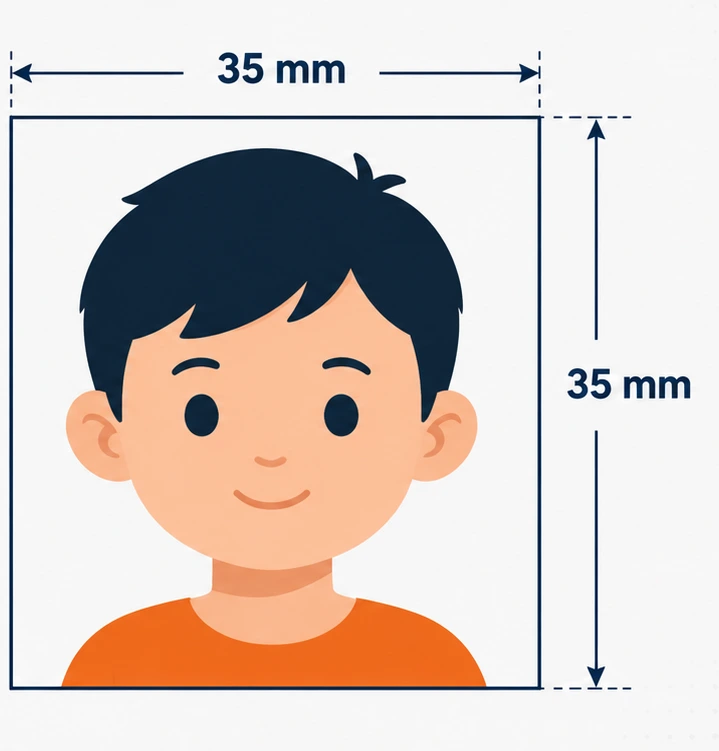
✅ Photograph requirements: JPEG format, minimum 10 KB and maximum 1 MB, with equal height and width. The photo should show your full face, front view, with eyes open and no spectacles. The head should be centred within the frame, showing the full head from the top of the hair to the bottom of the chin. The background should be plain, light-colored or white, with no shadows on the face or background, and no borders.
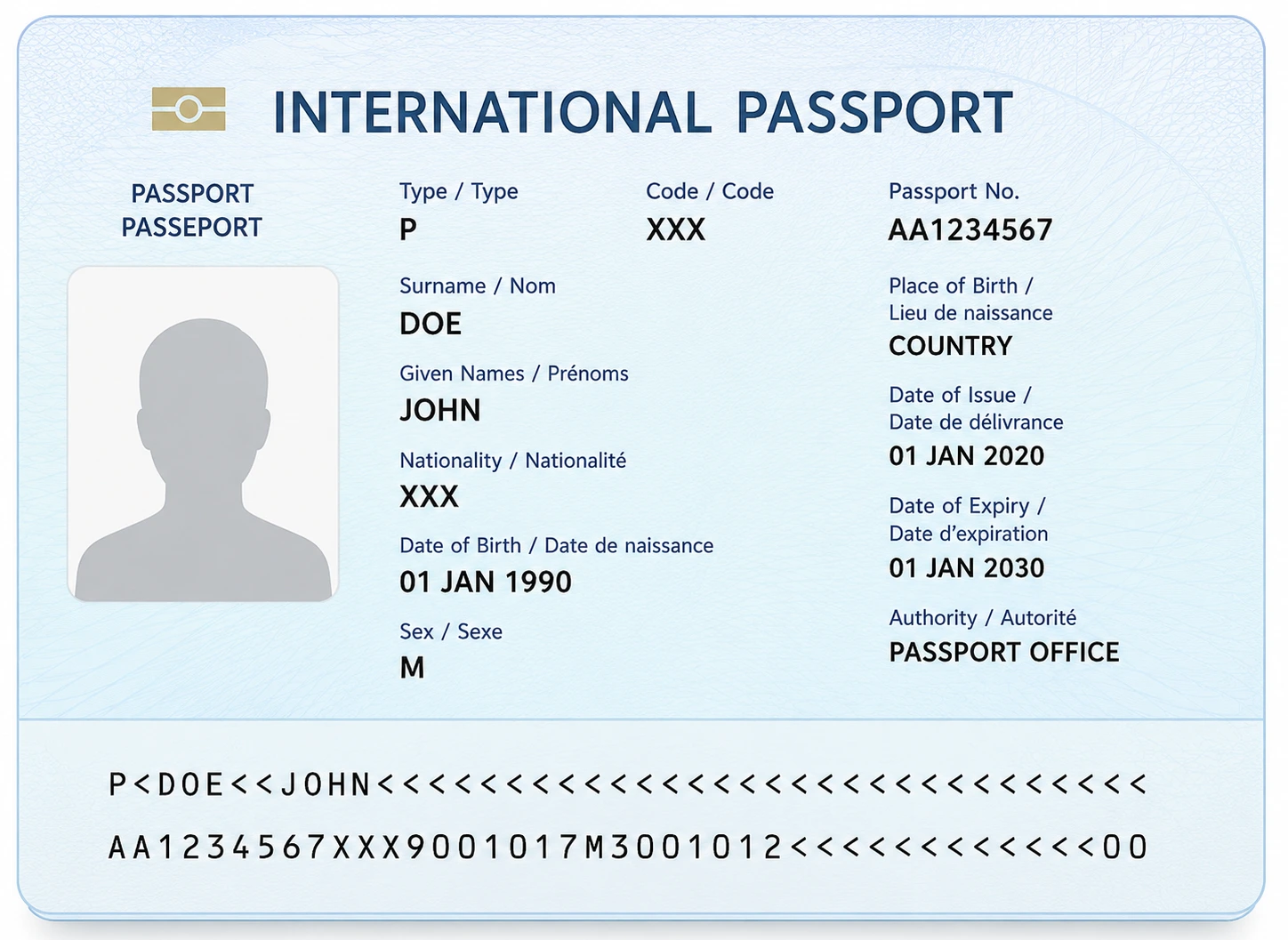
✅ Passport bio page scan: PDF format, minimum 10 KB and maximum 300 KB.
✅ Business or medical supporting documents: Same specifications — PDF format, minimum 10 KB, maximum 300 KB.
Note: All the documents must be in English.
The application itself typically takes 10 to 15 minutes to complete along with the payment — assuming your documents are already correctly formatted and ready to upload.
Where You Can Actually Enter India
Regardless of which visa category you hold, entry is restricted to designated ports. India e-Visa holders may enter India only through the designated international airports and seaports listed on the authorized entry and exit ports page, currently spanning dozens of airports including Delhi, Mumbai, Chennai, Kolkata, Bengaluru, Hyderabad, and Cochin, alongside a network of designated seaports for cruise arrivals. Exit is less restricted; departure is permitted from any Indian Immigration Check Post, not just the designated e-Visa entry points.
Both the India e-Tourist and e-Business Visa follow this same entry-point structure. Neither grants access to land border crossings outside the officially designated land ports, and neither permits entry into Protected, Restricted, or Cantonment Areas without separate prior permission.
Common Mistakes That Apply to Both Categories
📌 Applying under the wrong category to save money or time. Some travelers select the tourist visa for a trip that includes business meetings, assuming it's simpler or cheaper. This is a condition violation, not a shortcut; see the section above on why this matters. Review the full list of common application mistakes before submitting either category.
📌 Submitting a business card or invitation letter not in English. This is explicitly called out as grounds for rejection and is one of the most common e-Business Visa errors.
📌 Assuming either visa can be extended. Neither category can be extended under standard circumstances. If more time is genuinely needed, the FRRO registration route (for business visa holders nearing 180 days) or a fresh application (in limited circumstances) are the only paths — extension is not one of them.
📌 Not accounting for the 180-day FRRO registration deadline on the e-Business Visa. This has become a stricter requirement under recent immigration rule revisions, with registration now required before the 180-day mark is reached in many cases, rather than the grace period that previously applied.
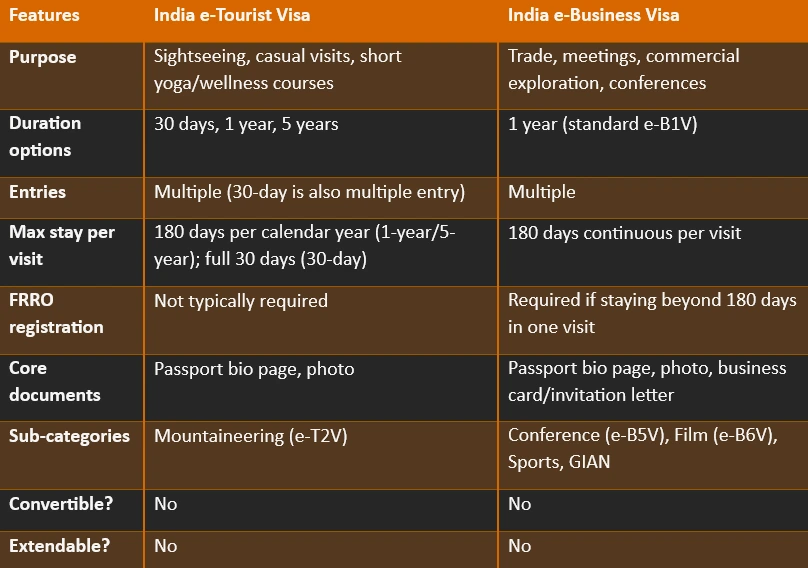
Quick Comparison: India e-Tourist Visa vs. India e-Business Visa
Why Apply Through IVC Visas?
Both the India e-Tourist and e-Business Visa are processed through the same official government portal, and neither IVC Visas nor any other agency can speed up government processing. No legitimate service can promise faster-than-standard grant of an India e-Visa, and applicants should be wary of any service claiming otherwise.
What IVC Visas provides is a review layer before your application reaches the government system: confirming you've selected the correct visa category for your actual travel purpose, checking that your business card or invitation letter meets the English-language and formatting requirements, verifying your photo and passport scan against the technical specifications, and flagging anything that would otherwise only be caught during manual government review, after your non-refundable fee is already committed.
Why stress out when IVC Visas is here to help!
Contact our team if you're unsure which category fits your trip, or start your application once you've confirmed the right one.
Disclaimer: IVC Visas is an independent visa service provider. We assist with application preparation and submission to official government portals. Final visa approval decisions are made solely by Indian immigration authorities. All information is based on current regulations as prescribed by the Government of India, which may change. Always verify the latest requirements before travel.