You’ve found your train on IRCTC, and then the booking screen shows a row of codes: 1A, 2A, 3A, SL, CC, EC, 2S. Nobody explains them. You guess, click the cheapest option that looks sensible, and find out at 9 pm on a crowded platform what you actually bought.
The classes are simple once someone translates them. IVC covers what each code means, which ones foreign tourists can book, what they really cost, and how to match a class to your route. We’ll also cover where your India e-Visa comes into it, because on Indian trains your passport and your visa matter as much as your ticket, and this is universal for every eligible foreigner from Russia, Canada, Brazil or more.
The Short Version:
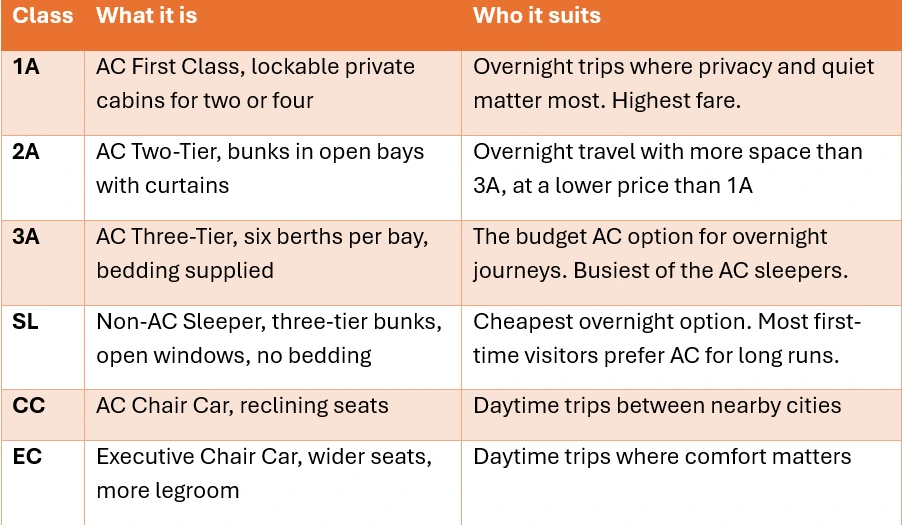
The letter tells you the type, and the “A” means air-conditioned. If you only remember one rule, remember that 1A, 2A and 3A are the AC sleeping classes, with 1A the most private and 3A the most crowded.
The Overnight Classes: 1A, 2A, 3A and SL
1A: First AC
The top of the ladder. Coaches have lockable cabins with two or four berths, and each coach carries far fewer passengers than any other sleeper class. It’s quiet and private, and it costs the most. Most visitors treat it as a splurge for one special leg rather than a default.
2A: Second AC
Many experienced travelers say this is the sweet spot. Berths are arranged in two tiers, which means more headroom and fewer neighbors, and each berth has a curtain for privacy. You get bedding and air conditioning without 1A prices.
3A: Third AC
Three tiers of berths and no curtains in most coaches, so it feels busier and tighter than 2A. You still get air conditioning and bedding, and the fare is noticeably lower. This is the most popular AC class on Indian trains. If you’re tall, expect the upper berths to feel snug.
SL: Sleeper
No air conditioning, open windows, fans, and three-tier berths. It’s the working backbone of Indian Railways and the cheapest way to travel overnight. It’s also the most local experience, which some travelers love and others find overwhelming on a first trip. Bring your own bedding or a sleeping sheet, since bedding is not normally supplied in this class.
3E (Third AC Economy):
You’ll see it mentioned online as a cheaper version of 3A. IRCTC’s Foreign Tourist Quota page does not list it among the classes available to foreign tourists, so don’t plan around it.
The Daytime Classes: EC, CC and 2S
EC: Executive Chair Car
Wider seats, more legroom and a more upmarket feel. It’s available only on select premium day trains, and it’s the priciest seated option.
CC: AC Chair Car
Air-conditioned seating on daytime trains. This is the standard choice for journeys of a few hours, like the hop from Delhi to Agra. Seats are comfortable, the carriage is clean on premium services, and it’s easy to keep an eye on your luggage.
2S: Second Sitting
Non-AC reserved seating, and the cheapest class on the list. It works for short, simple trips. On a hot afternoon, or anything over a couple of hours, most visitors find CC worth the extra money.
Which Classes Can Foreigners Actually Book?
This is where the official pages matter. IRCTC’s Foreign Tourist (FT) Quota guidance lists seven classes that foreign tourists can book:
Executive Chair Car (EC), First AC (1A), Second AC (2A), Third AC (3A), AC Chair Car (CC), Sleeper (SL) and Second Sitting (2S).
The quota covers many train types, including Shatabdi, Rajdhani, Duronto and Gatimaan. Suvidha trains are excluded. You need your passport number and nationality at the time of booking, and agents cannot book FT Quota seats for you.
What It Really Costs (Plan for More Than the Fare You See Online)
Many guides skip this part! IRCTC’s published FT Quota terms say the fare is charged at 1.5 times the normal fare. On top of that, there is a service charge of ₹200 plus GST per ticket and a one-time registration fee for international users of ₹100 plus GST. Payment is by international debit or credit card.
Because rules and fares get updated, trust the final amount shown on the booking screen before you pay. But budget for foreign-quota tickets costing noticeably more than the local fares you see quoted in blogs and forums.
🚨Cancellation is expensive too! IRCTC’s terms state that a flat 50% of the fare is deducted on top of the usual cancellation charges, and the refund has to be requested through the website, up to four hours before departure. No name changes are allowed under any circumstances, and there are no concessions. Think twice before booking a long chain of tickets early.
🚨 One Booking Detail That Surprises People!
You can book up to 365 days ahead, but the railway system itself currently opens reservations 60 days ahead. If you book beyond that window, your berth isn’t allotted at the time of booking. It’s allotted when that date enters the 60-day window. If no berth is allotted, the ticket is cancelled automatically and you’re refunded.
In practice, this means booking six months ahead doesn’t lock in a specific class on the day you pay. It’s more like a place in the queue. Keep a backup plan, particularly for popular overnight routes in peak season.
How to Pick the Right Class (By Journey)
Think about the length of the trip and the time of day first, then the budget:
- Under four hours, daytime: CC is the safe pick. Choose EC if the train offers it and you want extra space.
- A very short, cheap hop: 2S works, but only if you’re comfortable with basic seating.
- Overnight, first time in India: 2A or 3A. They give you air conditioning, bedding and a more predictable experience.
- Overnight, tight budget: SL, with eyes open. It’s cheap and memorable, but it’s busy, non-AC and noisy.
- Solo travelers wanting extra privacy: Many choose 2A or 1A. This is a common preference rather than a rule, and 3A is also widely used by solo visitors.
- Families or small groups: 1A cabins can be booked together, and 2A bays keep a group in one area.
For example, the Delhi to Agra run on the Gatimaan Express, one of the trains IRCTC names as eligible for the FT Quota, has chair car options and takes under two hours. An overnight journey down the west coast is a better fit for 2A or 3A.
Berth Tips for the Sleeper Classes
If you choose a sleeping class, a few small details change how well you rest:
- Lower berth: Easiest access, and it doubles as a seat during the day. Other passengers may sit on it until sleeping time.
- Middle berth: Folds down at night, so it’s cramped during the day if you’re in the same bay. It exists in 3A and SL, not in 1A or 2A.
- Upper berth: Quieter and more private, but a climb to reach, with less headroom.
- Side berths: Narrower and run along the corridor. Light and foot traffic can be an issue if you’re a light sleeper.
- Bring a small padlock and chain: You can secure your bag to the berth frame while you sleep.
Your India e-Visa and Your Train Ticket
Here’s the part many foreign tourists miss. IRCTC’s terms say you must carry your original passport with a valid visa during the journey. If you can’t show them, you can be treated as a passenger without a ticket and charged a penalty equal to three times the fare. Every passenger on a booking must carry their own passport and visa.
For travelers on an India e-Visa, that means keeping the passport you applied with, plus a printout of your approved ETA, in one easy place. A few things follow from this:
- Passport details must match everywhere. The passport number and name on your IRCTC booking, your e-Visa and your passport should all agree.
- Check your visa dates before booking. An India e-Visa cannot be extended. If a train departs after your visa expires, the ticket is useless.
- Apply for your visa first. The India e-Visa application opens 120 days before arrival, while trains can be booked up to 365 days ahead. With 50% of the fare lost on cancellation, a rejected or delayed visa is an expensive surprise.
Travelers from Greece to Mexico tend to underestimate how quickly small mismatches, a nickname instead of a passport name or a transposed digit, turn into delays. We review India e-Visa applications for exactly those errors before they reach the government portal.
Planning a multi-city rail trip? Talk to our team and make sure your visa dates cover every journey on your itinerary.
Common Mistakes to Avoid while Booking!
- Booking SL without checking what it means. It’s non-AC and open-windowed. Great for some, shocking for others.
- Assuming the class you want will be confirmed instantly. Bookings beyond the 60-day window don’t get a berth straight away.
- Forgetting the 1.5x fare. The price you read in an older blog may not match what the booking screen shows for foreign tourists.
- Cancelling casually. Half the fare is gone before the usual charges even apply.
- Carrying only a photo of your passport. The rule is the original passport with a valid visa.
- Booking trains before the visa is sorted. The cheapest way to avoid that stress is applying early, so start your India e-Visa application as soon as your dates are firm.
Why take stress for your journey to India when IVC exists to take care of your India e-visa application?
Get started soon!
Disclaimer: IVC Visas is an independent visa service provider. We assist with application preparation and submission to official government portals. Final visa approval decisions are made solely by Indian immigration authorities. All information is based on current regulations as prescribed by the Government of India, which may change. Always verify the latest requirements before travel.