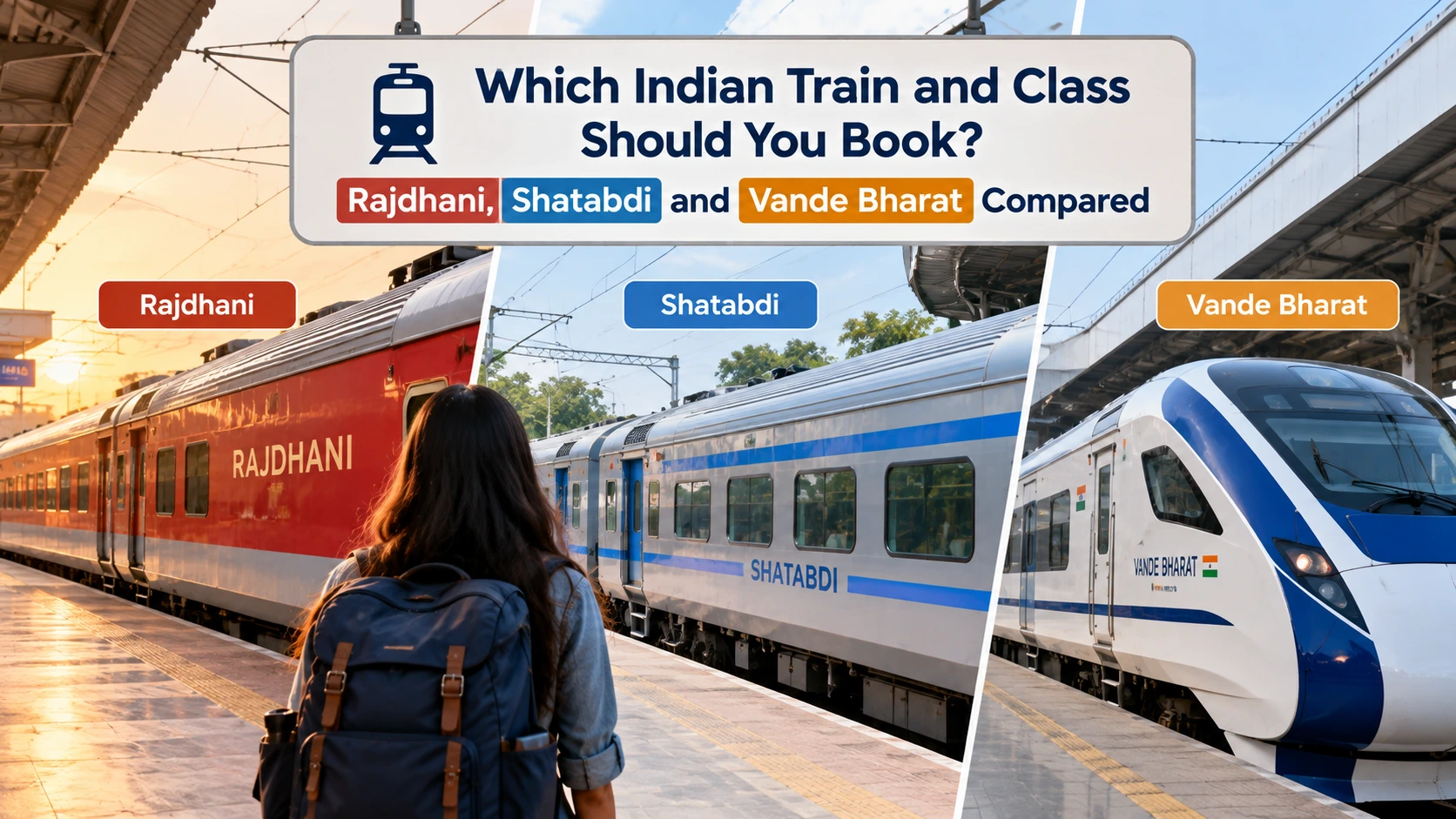
Which Indian Train and Class Should You Book? Rajdhani, Shatabdi and Vande Bharat Compared for India e-visa travelers!
The first time you open a train booking page for India, it asks you to pick between 3A, 2A, CC and EC, and nothing on the screen explains what any of them mean. Someone in your group says to take the cheapest. Someone else has read that Sleeper class is “an experience.” You close the tab and look at flights instead.
That is a pity, because the train is where a lot of India actually happens. A Rajdhani pulling out of Delhi at dusk with dinner arriving at your seat, or a Vande Bharat covering a few hundred kilometres while fields slide past a clean window: for a first-time visitor these are some of the easiest ways to cover ground, and some of the most memorable. You only need to know what the codes mean and which train offers which class.
IVC guides travelers from Poland, Romania and other eligible nationalities who hold an India e-Visa or are about to apply for one, which matters more for train planning than most people expect. We get to that in the middle.
What 1A, 2A, 3A, SL, CC and EC actually mean?
Indian Railways files every seat and berth under a class code, and the codes are about as self-explanatory as a departure board in a script you cannot read. They do fall into two families:
- classes you sleep in, built for overnight runs, and
- classes you sit in, built for daytime runs between cities.
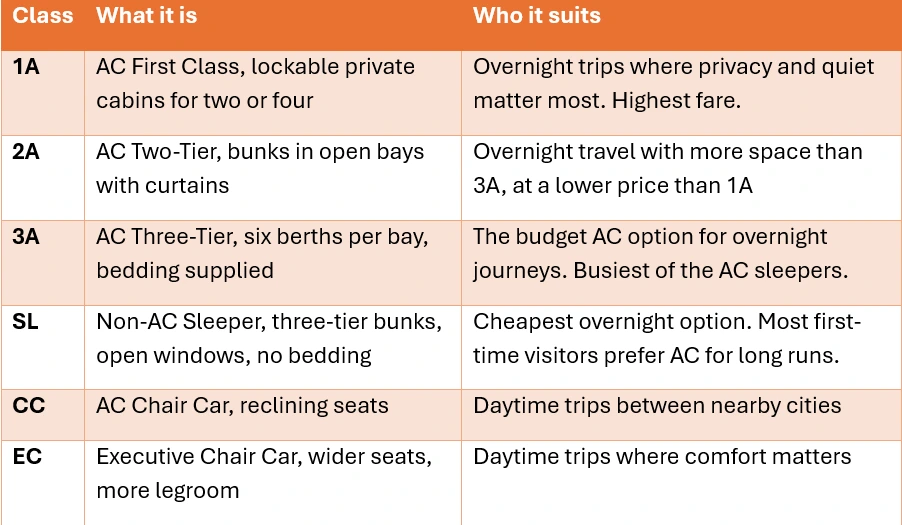
Two details settle most arguments. First, 3A and SL have a middle berth that folds down from the wall, while 2A and 1A do not, so there is no bunk waiting to catch your head during the day. Second, a 2A coach holds noticeably fewer people than a 3A coach, roughly 46 to 54 against 64 to 72, which is why it feels calmer and why curtains for each bay are possible at all. Bedding is normally supplied in 1A, 2A and 3A. In Sleeper, you bring your own.
You will also run into 3E, an economy version of three-tier AC on certain trains, and 2S, plain second-sitting seats meant for short hops. Most tourists never need either.
Rajdhani vs Shatabdi vs Vande Bharat: How they actually differ?
The class code tells you what you are sitting or sleeping in. The train name tells you which classes you will be offered at all, so it helps to know both.
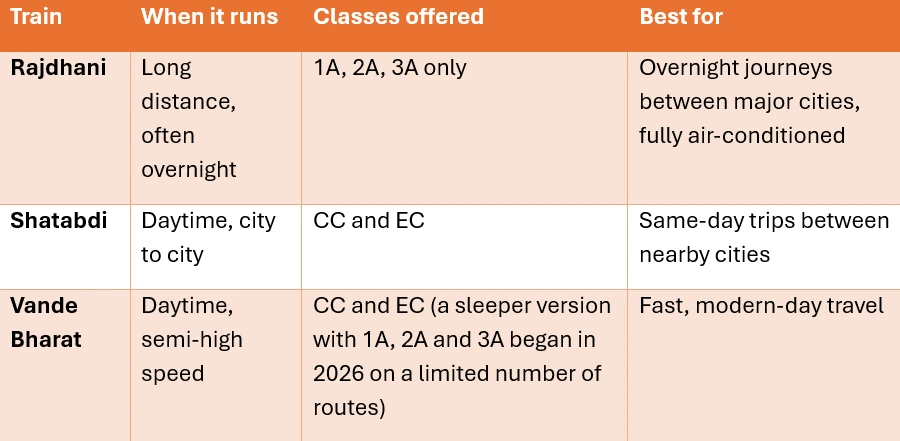
Rajdhani:
These were created to link the capital with major cities, and many of them run overnight. There is no Sleeper class and no chair car, so everyone on board is in air conditioning with bedding provided. Meals are normally built into the fare, which means dinner and breakfast turn up without you organizing anything. That is the whole appeal: you board, eat, sleep, and wake up somewhere else.
Shatabdi:
The day-train workhorse. Shatabdis shuttle between city pairs close enough to manage in a single day, with reclining chair car seats and an executive class for more room. Food and drinks are typically included here too. On some routes the newer Vande Bharat has taken over from the Shatabdi, so check which of the two actually runs at the time you want.
Vande Bharat:
The newest of the three and among the fastest trains in the country. Interiors are modern, the ride is smooth, and seating is again chair car or executive chair car. For a daytime hop between two cities it is often the most comfortable option on the board, though it only runs on selected routes. A sleeper version began services in January 2026 with 1A, 2A and 3A classes, but the route list is still short. Treat it as a bonus if it happens to serve your route, not something to build an itinerary around.
Other than these, Duronto trains run long distances with few stops. Superfast, Mail and Express trains are the everyday network, usually offering SL, 3A and 2A. They are perfectly workable, just slower and less polished, and catering is usually separate.
Which class suits which trip?
➤ For a daytime hop of a few hours, such as between two cities on a Golden Triangle style route, chair car on a Shatabdi or Vande Bharat does the job. Pay for executive chair car if you want wider seats, room for a laptop, or you will be on board for most of the day.
➤ For your first overnight train, 2A or 3A are the sensible starting points. 3A is the best value among air-conditioned options, while 2A trades a higher fare for fewer neighbours and curtains. If you want a closed door and you are traveling as a pair, 1A is the one class where that is possible. Choosing a Rajdhani for the overnight leg removes the guesswork, since every class on it is air-conditioned.
➤ Sleeper class is the budget route: no air conditioning, open windows, no bedding. It is a fair choice for short daytime stretches if you are curious, but for a long overnight run you will usually be more comfortable in an AC class.
➤ Business travelers on an India e-Business Visa often favour day trains for city-to-city trips. The journey time doubles as work time and you arrive without having lost a night. Tourists on a tight schedule get the same benefit.
If you try convert your India e-business into a tourist one, then that is not possible. IVC guides you through India visa regulations so you don't suffer ahead in your journey.
Where your India e-Visa fits in before you choose a seat?
Train tickets and visa approvals look like separate chores. In practice, the order you do them in can save you money and stress.
📌 Visa first, tickets second.
The months when Rajdhani and Vande Bharat seats vanish fastest, roughly October to March, are the same months India e-Visa applications run slowest. Real-world processing currently averages 8 to 10 business days, so apply at least 2 to 3 weeks before you travel, and 3 to 4 weeks in peak season. It is tempting to grab train seats the moment your dates are fixed. Wait for your ETA to show Granted first. Tickets can be cancelled, but cancellation costs money, and the exact train you wanted rarely comes back on a popular route.
📌 Spell names the way your passport does.
You will type passenger names into the railway booking form just as you typed them into your visa application, so treat both with the same care: letter for letter as printed on the passport. A mismatch on a visa application can lead to rejection, and a ticket name that does not match the ID you carry invites questions on board.
📌 Keep your passport and printed ETA within reach.
Hotels in India register foreign guests by asking for your passport and visa, and ticket checkers on trains can ask for ID. Keep both in your day bag, not buried in luggage.
📌 Count your days before you build a rail loop.
The 30-day India e-Tourist Visa starts on the day you first arrive, not the day you apply. The 1-year and 5-year versions cap your total stay at 180 days per calendar year. A sweeping route from the north down to Kerala and across to Kolkata looks wonderful on a map and can quietly eat your permitted days. Add them up before booking anything.
📌 Mind where the trip starts.
Your India e-Visa works only through authorised ports of arrival, so your first landing has to be at one of them. You can check the authorised ports list before you book flights. The rail network takes over from there, and the same rule applies if you are crossing overland. Whichever way you arrive, complete the e-Arrival Card within 72 hours before arrival, before you board your flight and not on the platform at the other end.
📌 Stay within your visa’s purpose.
The India e-Tourist Visa covers sightseeing by train across the unrestricted parts of India. If any leg of your trip is business, you need the India e-Business Visa instead, and no class of travel changes that.
Planning a rail-heavy route? Get the visa sorted before the seats. IVC Visas checks your India e-Visa application, photo and documents before submission, on both standard and express service, so your ETA is in hand when you open the booking page.
A few habits that make rail days easier!
✅ Check the station name on your ticket twice. Delhi alone has several major stations, and cities like Mumbai and Kolkata do too. The wrong one can be a long, expensive taxi ride from the right one.
✅ Turn up early. Platform numbers can change at short notice, and at larger stations coach positions are shown on boards and printed charts. Take a minute to find your coach before the train rolls in.
✅ Pack for air conditioning. AC coaches can run cold overnight, even in warm months. A light layer helps, and so does a small lock or chain for your luggage if you plan to sleep.
✅ Expect delays in winter. Fog across northern India between December and February regularly slows trains. Never leave a rail leg for the last day of your visa, or as your only link to an international flight. A late train does not extend your visa, and overstaying brings penalties and an Exit Permit requirement before you can leave. Leave a buffer day, and if an emergency leaves you unable to depart in time, apply for an extension at indianfrro.gov.in before your visa expires, not after.
✅ Keep your documents offline. Mobile networks drop on long rural stretches, so save digital tickets to your phone and carry paper copies of your visa and passport pages.
Pick your dates, secure the visa, then pick your seat!
Once the codes make sense, choosing is easy: chair car for daytime hops, 3A or 2A for your first overnight run, and a Rajdhani or Vande Bharat whenever one serves your route. What can derail a rail itinerary is the visa, since seats booked against dates you cannot confirm are a gamble.
At IVC Visas, we review your application, category and documents before submission, with standard and express service depending on how close your departure is.
Check your eligibility, see current pricing for your nationality, and start your India e-Visa application with enough runway to book the trains you actually want. If you are unsure how to time a rail-heavy itinerary, talk to our team.
Disclaimer: IVC Visas is an independent visa service provider. We assist with application preparation and submission to official government portals for India e-Visa applications. Train routes, classes, fares and booking rules are set by Indian Railways and can change, so verify current details on the official railway booking platform before you travel. Final visa approval decisions are made solely by Indian immigration authorities. All information is based on current regulations as prescribed by the Government of India, which may change. Always verify the latest requirements before travel.