
Most people assume that visiting India means applying for an India visa. For the vast majority of nationalities, that's correct, but not for all. Citizens of France, Malaysia, Ireland and other 170 countries are eligible for an India e-visa, but what about rest?
A small number of countries enjoy visa-free entry into India, three nationalities have access to a Visa-on-Arrival facility, and OCI cardholders are exempt entirely regardless of which passport they carry.
On the other end of the spectrum, certain nationalities are not eligible for an India e-Visa at all and applicants with those nationalities need to know that before they start an application.
Category 1 | Visa-Free Entry: Nepal, Bhutan, and Maldives
Exemption from the requirement of an Indian visa or visa-free entry into India is available for the citizens of Nepal, Bhutan, and Maldives. These are the only three nationalities that currently enjoy this status.
✔️ Guidelines for Nepal and Bhutan
Under the Ministry of Home Affairs' Immigration and Foreigners (Exemption) Order 2025, notified in September 2025, citizens of Nepal and Bhutan entering India by land or air are not required to furnish a passport or India visa. This confirmed and formalized what has been a long-standing bilateral arrangement; the free movement treaty between India and Nepal, and India and Bhutan.
However, there is a specific and important exception: citizens of Nepal and Bhutan must be in possession of a valid passport and visa for India if entering from China, Macau, Hong Kong, or Pakistan. The visa-free status applies when entering from their respective countries or from third countries other than those listed.
What to Carry Instead of a Passport?
Not needing a passport doesn't mean travelling with nothing. The Ministry's order specifies acceptable alternative proof of identity for Nepali and Bhutanese citizens entering directly from their own country:
- A valid citizenship certificate
- A voter ID card issued by the respective national election commission
- For children aged 10 to 18, a school-issued photo ID, provided they're travelling with a parent or guardian carrying valid documents
- Children under 10 need no separate identity document at all
This detail matters in practice: immigration officers at land crossings and airports are checking for one of these specific documents, not simply waving travelers through without any form of ID. Carrying an expired or informal document that isn't on this list can still cause delays, even though no passport or visa is required.
✔️ Guidelines for Maldives
Visa-free entry can be availed by Maldivians whose purpose of visit to India is exclusively for business, medical treatment, or tourism, and the stay in India does not exceed 90 days in the preceding six months. Maldivian nationals visiting for any other purpose, or whose cumulative stay has exceeded 90 days in the preceding six months, are required to obtain a India visa before travel.
The Law Behind the Exemption
The September 2025 order didn't appear in isolation, it's part of a broader overhaul of how India regulates foreign nationals entering the country.
- The Immigration and Foreigners Act, 2025, effective September 1, 2025, replaced a patchwork of older legislation, including the Passport (Entry into India) Rules, 1950, and the Foreigners Order, 1948, with a single consolidated framework.
- Alongside the Nepal/Bhutan exemption, the Act introduced mandatory biometric registration for foreigners applying for a visa or an OCI card, a change relevant to anyone applying for an India e-Visa going forward, not just visa-exempt nationalities.
- The Act also formally retired the Foreigners Order, 1948 as the operative legal basis for these rules, replacing decades-old colonial-era legislation with current-day standards.
For most India e-Visa applicants, this legal shift happens entirely behind the scenes. But it's worth knowing that the exemptions covered in this article sit inside a much larger modernization of India's immigration system, not a standalone concession.
Category 2 | Visa-on-Arrival: Japan, South Korea, and UAE
Three nationalities have access to India's Visa-on-Arrival (VoA) facility: an India visa issued at the immigration counter on arrival rather than applied for in advance.
The Visa-on-Arrival facility is available for nationals of Japan, the Republic of Korea, and the United Arab Emirates, for a period not exceeding 60 days, for the purposes of business, tourism, conference, and medical visits.
Each nationality has specific conditions:
✔️ Japan and South Korea
Eligible for VoA provided they are not of Bangladeshi or Pakistani origin.
✔️ UAE
VoA is available only to those UAE nationals who had earlier obtained an India e-Visa or regular sticker/paper visa for India. First-time visitors from the UAE who have never previously held an Indian visa in any form are not eligible for VoA and must apply for an India e-Visa before travel. If you wish to apply for a regular visa, you must visit Diplomatic Mission of India in UAE.
While the VoA facility exists, the India e-Visa remains the recommended route for all three nationalities, particularly for first-time visitors. The India e-Visa is pre-approved before departure, accepted at 33 designated airports, 33 seaports, and 4 land ports, and removes all uncertainty at the arrival counter.
Good news? IVC Visas has managed a significant amount of India e-visa applications from all the eligible countries around the globe and we can guide you too, on your journey to India!
Category 3 | OCI Cardholders: Visa-Exempt Regardless of Nationality
Overseas Citizen of India (OCI) cardholders are exempt from the India visa requirement entirely — regardless of which country's passport they hold. A British national, a German national, an Australian national, or any other nationality holding a valid OCI card does not need to apply for an India e-Visa or any other India visa.
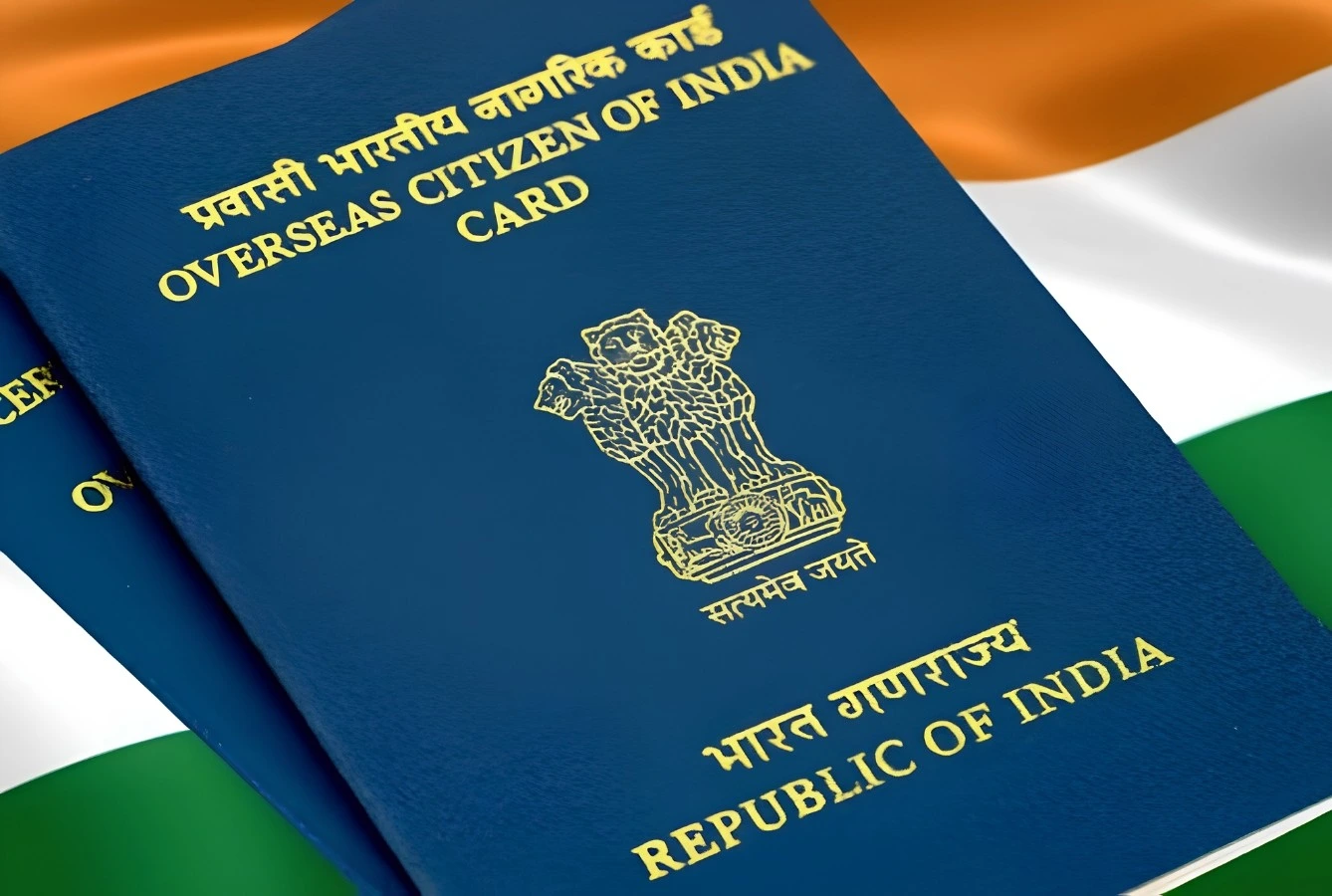
The OCI card also grants multiple-entry, multi-purpose lifelong visa-free travel to India with certain restrictions on specific activities such as research, missionary work, or mountaineering, which require additional permission.
OCI cardholders must still complete the mandatory e-Arrival Card within 72 hours before arrival.
The Person of Indian Origin (PIO) Card scheme was merged into the OCI scheme on January 9, 2015. No new PIO cards are issued. Existing PIO cardholders were required to convert to OCI cards. The PIO Card scheme is now defunct and any reference to it as an active scheme is outdated.
Category 4 | India e-Visa Eligible Nationalities
The majority of the world's nationalities, currently over 160 countries, are eligible for India e-Visa. This covers tourism, business, medical treatment, conferences, and several other purposes. Applications are submitted through the official Indian government portal, processed online, and the Electronic Travel Authorization (ETA), approved India e-visa is delivered by email.
What the India e-Visa Actually Covers:
For the 160-plus eligible nationalities, the e-Visa isn't a single product; it's a system of separate categories built around purpose of travel:
- Tourist Visa: leisure travel, visiting friends or family, short yoga or wellness programs
- Business Visa: meetings, trade fairs, technical or business discussions
- Medical Visa: treatment at a recognized Indian hospital, plus a matching Medical Attendant category for accompanying family
- Student Visa: enrolment at a recognized Indian institution for short-term courses
- Several narrower categories exist beyond these, covering film crews, conference attendance, transit, and investment-linked travel.
Each category carries its own validity period, entry allowance, and fee, which is why picking the correct category before applying matters as much as being eligible in the first place. An eligible nationality applying under the wrong category is still likely to face rejection, and the government fee doesn't come back either way.
Verifying eligibility before applying isn't just a formality for someone unsure of their nationality status; it also confirms which category actually fits the trip.
Category 5 | Not Eligible for India e-Visa: Who Must Take a Different Route
Not every nationality can access the India e-Visa. The following categories are explicitly excluded and must apply through the Indian Mission in their country of residence for a regular sticker visa:
🚫 Pakistani nationals
Citizens of Pakistan are not eligible for an India e-Visa under any circumstances. A regular visa must be applied for in person through the relevant Indian Mission.
🚫 Those of Pakistani lineage
Nationals of any country whose parents or grandparents (paternal or maternal) were born in or were permanently resident in Pakistan are also not eligible for an India e-Visa, regardless of which passport they currently hold.
🚫 Diplomatic, official, service, and special passport holders
Holders of diplomatic, official, service, or special category passports from any country are not eligible for the India e-Visa. They must apply through the Indian Mission.
🚫 Laissez-passer and non-standard travel document holders
The India e-Visa is only available to holders of ordinary passports. Holders of laissez-passer documents or any international travel document other than a standard ordinary passport are not eligible.
🚫 Individuals with a defence, military, security, or police background
Whether serving or retired, such individuals are not eligible for an India e-Visa. Entry under a suppressed background is grounds for deportation on arrival.
🚫 Individuals endorsed on a parent's or spouse's passport
The India e-Visa is not available to those who are not individually passported. Each traveler must hold their own passport.
For anyone in the categories above, the appropriate route is to contact the Embassy or High Commission of India in their country and apply for a regular India visa through the established consular process.
What Happens If an Ineligible Nationality Applies Anyway?
Occasionally, someone in one of the excluded categories above attempts an e-Visa application regardless, sometimes unintentionally, sometimes hoping the system won't catch it. It's worth being direct about the outcome:
- The application is reviewed against nationality and background data the applicant provided; a mismatch with an excluded category typically results in rejection.
- The government e-Visa fee is non-refundable regardless of the reason for rejection, so an ineligible application doesn't just fail, it costs the applicant the full fee with nothing to show for it.
- For Pakistani nationals and those of Pakistani lineage specifically, immigration authorities apply this rule strictly, and there is no appeal process through the e-Visa system itself, only through the regular consular visa route.
- Attempting entry under a suppressed or undisclosed defence, military, or security background, even after an e-Visa is somehow granted, is treated as a serious matter at the immigration counter and can result in deportation on arrival.
The safer path for anyone uncertain which category they fall into is confirming with the Embassy or High Commission of India in their country before attempting any application, e-Visa or otherwise.
Where IVC Visas Fits In?
IVC Visas handles India e-Visa applications for the 160+ nationalities eligible to apply online. If you hold an ordinary passport from an eligible country and your travel purpose qualifies, our team reviews your application, photo, and documents before submission to ensure everything is correct before a non-refundable fee is committed.
If you're unsure which category applies to you, contact our team to know the best before you start!
Disclaimer: IVC Visas is an independent visa service provider. We assist with application preparation and submission to official government portals. Final visa approval decisions are made solely by Indian immigration authorities. All information is based on current regulations as prescribed by the Government of India, which may change. Always verify the latest requirements before travel.