
India has always drawn travelers in — ancient temples, palace cities, backwater canals, chaotic bazaars that somehow make sense. For UAE nationals, the pull is just as strong, and getting there has never been more straightforward.
If you hold a UAE passport and you're planning a trip to India, here's exactly what you need — no fluff, no guesswork.
Do UAE Nationals Need a Visa for India?
Yes. UAE passport holders are required to obtain an Indian visa before travelling to India. An option of Visa-on-Arrival (VoA) avails for Emirati nationals though.
Option 1: Visa-on-Arrival (VoA)
As of November 2025, India offers a Visa-on-Arrival for Emirati nationals at nine designated airports — Delhi, Mumbai, Bengaluru, Chennai, Hyderabad, Kolkata, Kochi, Calicut, and Ahmedabad. The VoA allows a stay of up to 60 days, covers tourism, business, conferences, and medical visits, permits double entry within those 60 days, and can be used an unlimited number of times per year. The fee is approximately INR 2,000 (≈ AED 90), paid at the immigration counter on arrival.
Option 2: India e-Visa (Recommended)
The India e-Visa is applied entirely online before you travel. You fill in the form, upload your documents, pay the visa fee, and receive your Electronic Travel Authorization (ETA) by email. No airport counter, no on-arrival paperwork, and no embassy visits.
For first-time visitors, the India e-Visa is the cleaner, safer choice. For frequent travelers who've previously held an Indian visa, the VoA offers a convenient, low-friction option on return trips.
A couple of important distinctions worth knowing upfront:
- OCI (Overseas Citizen of India) cardholders — regardless of which passport they hold — do not need an India visa. If you hold an OCI card, you're exempt.
- Diplomatic, official, or service passport holders are not eligible for an Indian e-Visa. They must apply through the Embassy of India in Abu Dhabi or the Consulate General in Dubai.
Check your eligibility before starting — it takes less than a minute.
India e-Visa Categories for UAE Nationals
UAE passport holders can apply for all five India e-Visa categories. Choosing the right one matters — applying under the wrong category is one of the most common mistakes that leads to rejection.
e-Tourist Visa: For holidays, sightseeing, visiting friends or relatives, yoga retreats, or short recreational courses. Available in three durations — 30 days (double entry), 1 year (multiple entry), and 5 years (multiple entry). The 1-year and 5-year options cap cumulative stays at 180 days per calendar year. See the India e-Tourist Visa for full details.
e-Business Visa: For business meetings, trade visits, industrial tours, or exploring investment opportunities. Valid for 1 year with multiple entries, each stay not exceeding 180 days. Given the volume of India-UAE business activity in recent years, this is an increasingly used category. See the India e-Business Visa.
e-Medical Visa: India is a major destination for medical treatment from the Gulf region — advanced procedures at a fraction of the cost. The e-Medical Visa is valid for 60 days with triple entry and requires a letter from the treating hospital in India. See the India e-Medical Visa.
e-Medical Attendant Visa: For companions travelling alongside an e-Medical Visa holder. Up to two attendants are permitted per patient. Validity mirrors the patient's visa — 60 days, triple entry.
e-Conference Visa: For attending conferences, seminars, or workshops organized by Indian government bodies or recognized institutions. Requires an official event invitation and, in some cases, political clearance.
Documents UAE Nationals Need for the India e-Visa
Get these ready before you begin — the application form itself takes 10–15 minutes, but scrambling for documents mid-way is where errors creep in.
✔️ Valid UAE passport (ordinary) — minimum 6 months validity from your intended India arrival date, with at least 2 blank pages for immigration stamps
✔️ Scanned passport bio page — clear, coloured scan showing name, date of birth, nationality, and expiry date
✔️ Recent passport photograph — JPEG format, plain white background, no glasses, taken within the last 6 months
✔️ Valid email address — your approved ETA is sent here; double-check before submitting
✔️ Payment method — credit or debit; a bank transaction charge of 3% applies additionally on the visa fee
✔️ Category-specific documents — business invitation letter (e-Business), hospital letter from India (e-Medical), event invitation (e-Conference)
Not sure if your photo or passport scan meets the required specifications? This is exactly the kind of issue that gets flagged during processing. IVC Visas lays down the documents requirements and even reviews before your application reaches the portal.
How to Apply Through IVC Visas?
Applying through IVC Visas means your application is reviewed by our team before it's submitted — catching errors in document format, passport details, or photo compliance that would otherwise cause a rejection or delay.
Choose your method:
Option A — IVC Visas completes the full application on your behalf. You provide the information and documents; we handle the rest.
Option B — You fill the application yourself, and our team reviews and corrects it before submission.
Start with IVC| Follow step by step!
Step 1: Fill in your application — nationality, visa type, travel dates, personal and passport details.
Step 2: Upload your passport bio page and photograph. For business or medical visas, upload the required supporting document.
Step 3: Pay the visa fee at checkout. Fees vary by visa type and duration — check the current India e-Visa fee for UAE nationals before applying. All fees are non-refundable once submitted.
Step 4: Once approved, your ETA arrives by email as a PDF. Download it, print it, and carry a physical copy to India.
The official processing window is 72 hours, but processing currently averages 8–10 business days. Apply at least 2–3 weeks before your travel date. Once submitted, track your application status through the portal and ensure it reads 'GRANTED' before you fly — never travel on a pending status.
Which Airports Can UAE Nationals Enter India Through?
An e-Visa does not grant entry through every airport in India. You must arrive through one of India's designated e-Visa enabled airports or seaports. All major international gateways are covered — Delhi, Mumbai, Bangalore, Chennai, Hyderabad, Kochi, Kolkata, and others — but confirm your specific entry point before booking.
Check the full authorised entry and exit ports list. Most direct flights from Dubai and Abu Dhabi land at e-Visa approved airports, but it's worth a quick check particularly if your itinerary involves a less common routing.
Other Critical Guidelines for UAE Applicants:
Visa Extension: India e-Visas cannot be extended once issued. If you need to stay longer, you must exit India before your visa expires and reapply from outside the country. In genuine emergencies, the Foreigners Regional Registration Office (FRRO) may be approached — offices are in Delhi, Mumbai, Kolkata, Chennai, Bengaluru, Hyderabad, and Amritsar — but approval is not guaranteed.
Conversion of Visa: An India e-Visa cannot be converted into any other visa category (employment, student, research) while inside India.
Long-term purposes: For employment, full-time study, or research, a regular sticker visa is required — applied for through the Embassy of India in Abu Dhabi before travel.
Restricted areas: Parts of the Andaman & Nicobar Islands, Sikkim, and Arunachal Pradesh require a Protected Area Permit (PAP) in addition to your e-Visa. Apply for this separately in advance.
Same passport rule: You must travel on the exact passport used to apply. If you've renewed your passport since applying, carry both — old and new — to avoid any issue at immigration.
When UAE Nationals Visit India?
The most popular travel window from the Gulf to India is October to March — when North India's weather is at its best and the summer heat across the UAE has passed. This is also peak season across Rajasthan, Kerala, and Goa, so applying early is important as processing times can lengthen during high-demand periods.
UAE nationals visiting India tend to head to Kerala for Ayurveda and wellness retreats, Rajasthan for its palaces and desert landscape, Mumbai for shopping and food, and Goa for beaches. The Golden Triangle — Delhi, Agra, Jaipur — remains the most popular first-time circuit.
If you're travelling between October and January, apply for your India e-Visa at least 3 weeks in advance.
Summary Checklist for UAE Applicants
✔️ Confirm you hold an ordinary UAE passport — not diplomatic, official, or service
✔️ Check OCI card status if applicable — OCI holders don't need a visa
✔️ Passport valid for 6+ months from arrival date, with 2 blank pages
✔️ Choose the correct India e-Visa category before applying
✔️ Clear passport bio page scan and compliant JPEG photo ready
✔️ Supporting documents prepared if applying for business, medical, or conference visa
✔️ Verify your entry airport is on the authorized India e-Visa ports list
✔️ Apply at least 2–3 weeks before travel — current processing averages 8–10 business days
✔️ Check your status reads 'GRANTED' before flying
✔️ Print your ETA — carry a physical copy.
Why Apply Through IVC Visas?
The India e-Visa process looks straightforward — until something goes wrong. A photo that fails the format check, a passport detail entered incorrectly, a document uploaded at the wrong resolution — any of these can trigger a rejection or stall your application mid-review, and the fee is gone either way.
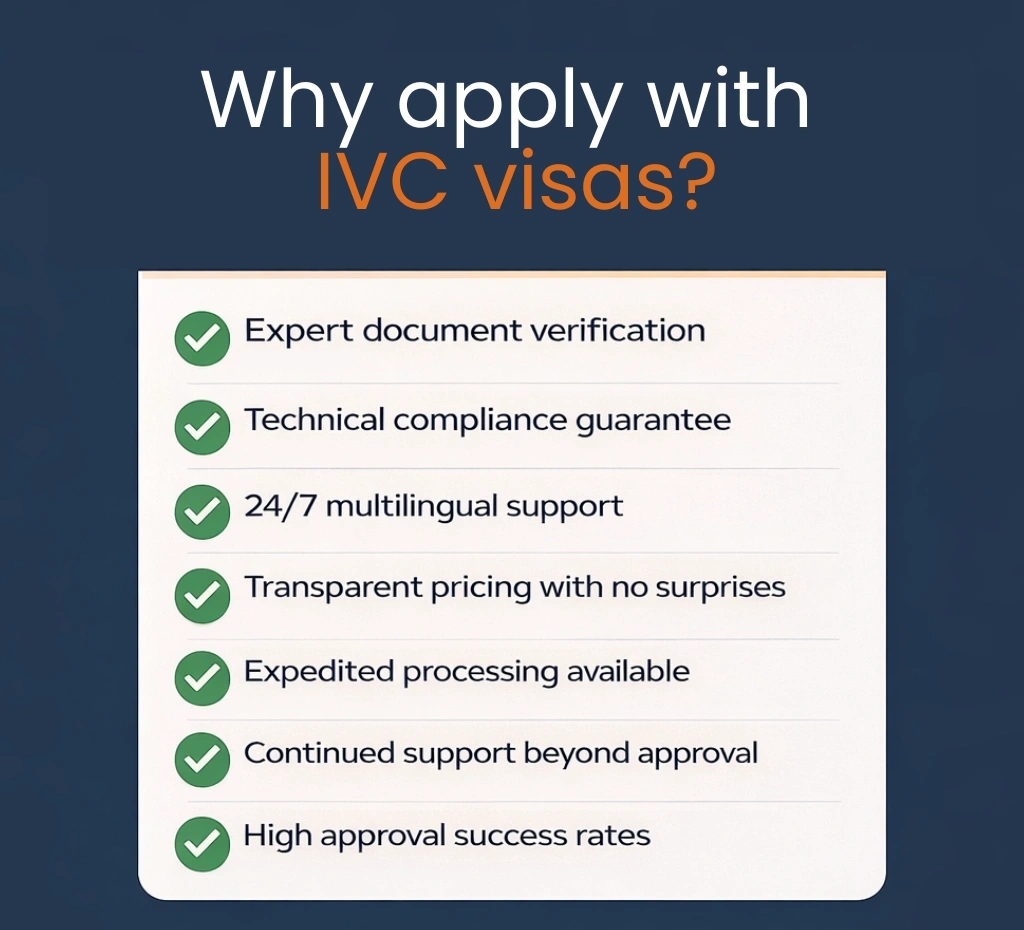
At IVC Visas, our team reviews every application before it reaches the portal. Photo compliance, document formatting, passport data accuracy — we check it all. And if something comes up after submission, our 24/7 support via Chat, WhatsApp, and Email means you're not navigating it alone.
Disclaimer: IVC Visas is an independent visa service provider assisting with application preparation and submission to official government portals. Final visa approval decisions are made solely by Indian immigration authorities. All information is based on current regulations as prescribed by the Government of India, which may change. Always verify the latest requirements before travel.