India e-Visa for Senior Citizens. What's the Same, What Matters More, and What to Prepare For?
India draws older travelers in significant numbers, for the Golden Triangle's history, for Kerala's slower pace, for the spiritual weight of Varanasi, for retirement-stage bucket-list trips that finally have the time to happen.
The question senior travelers ask before any of it is straightforward: are the visa rules different for me?
The honest answer, confirmed directly from the official Indian e-Visa portal: No.
There is no separate India e-Visa category for senior citizens, no age-based fee discount, and no fast-track processing tied to age. The application process, the documents required, and the eligibility conditions are identical regardless of whether the applicant is 25 or 85.
What changes is not the rulebook, it's the preparation that matters most. Here is what every senior traveler needs to know.

There Is No Special India e-Visa Category for Seniors
This needs stating clearly because third-party sites sometimes imply otherwise. The official Indian e-Visa portal lists nine categories:
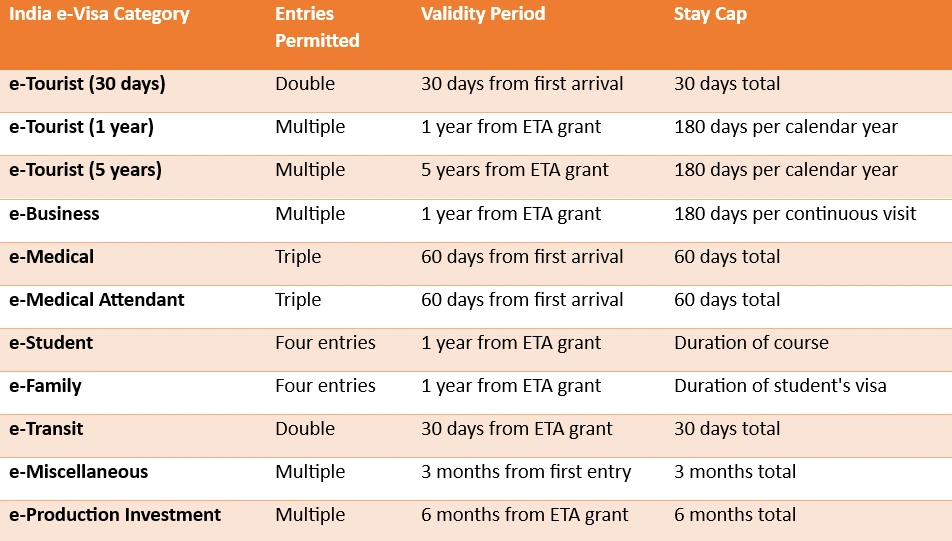
None of them is age-restricted or age-specific. Eligibility for India e-Visa services is based on nationality and purpose of visit:
Recreation and sightseeing, visiting friends and relatives, short-term courses, voluntary work, medical treatment, business, or attending a conference; with no age criteria stated anywhere in the official conditions.
For most senior travelers visiting India for tourism, the India e-Tourist Visa is the correct category, available in 30 days, 1 year, and 5 years, exactly as for any other applicant. For seniors travelling for medical treatment at an Indian hospital, the India e-Medical Visa is the relevant category, and a parent or spouse accompanying them can apply for an e-Medical Attendant Visa under the same conditions available to any age group.
There is no official fee reduction, discount, or waiver tied to age.
The India visa fee is set by nationality and visa category alone. Treat any website claiming a "senior citizen discount" on the India e-Visa with caution; this is not confirmed anywhere in official Indian government documentation.
Whether you are a citizen of Austria, Saudi Arabia, Germany or any other eligible nationality, you must pay the exact India e-visa fee (according to nationality and visa category), irrespective of your age.
What You Need to Apply - Same for Every Age
The documents are identical regardless of how old the applicant is:
- Valid ordinary passport with minimum 6 months validity from intended India arrival date, at least 2 blank pages
- Scanned passport bio page as in colour PDF, 10 KB–300 KB, all details legible
- Recent photograph in JPEG, 10 KB–1 MB, plain white background, no glasses, taken within 6 months
- Valid email address for ETA delivery. it must be active. Wrong ID or a typo in ID will prevent your ETA delivery.
- Payment card (debit/credit); with 3% bank transaction charge applies additionally
There is no medical certificate requirement, no fitness-to-travel declaration, and no companion mandate built into the India e-Visa application itself for senior travelers applying for standard tourism. Some private travel insurance providers impose their own age-related conditions, but the Indian government's visa application does not.
Where Preparation Genuinely Matters More for Senior Travelers
While the visa process itself is identical, several practical factors are worth far more attention for older travelers than the rulebook alone suggests.
1. Photo specifications can trip up older applicants more often.
The official photo requires plain white background, no glasses, taken within six months, JPEG format and that applies to everyone, but errors here are disproportionately common among senior applicants less familiar with digital photo editing and file conversion. A photo taken with glasses on (a frequent oversight) or saved in the wrong format is the single most common reason any application, regardless of age. Review the photo and document requirements carefully, or have a family member assist before submitting.
Even better, get assistance from IVC Visas for the document requirements for an India e-visa.
2. Travel insurance is not required by the Indian government, but it matters considerably more for older travelers.
Medical costs for foreign nationals in India, while lower than in many Western countries, can still be significant for unplanned hospital care. Confirm your travel insurance explicitly covers your age bracket and any pre-existing conditions before departure; some standard policies exclude or limit coverage above a certain age threshold.
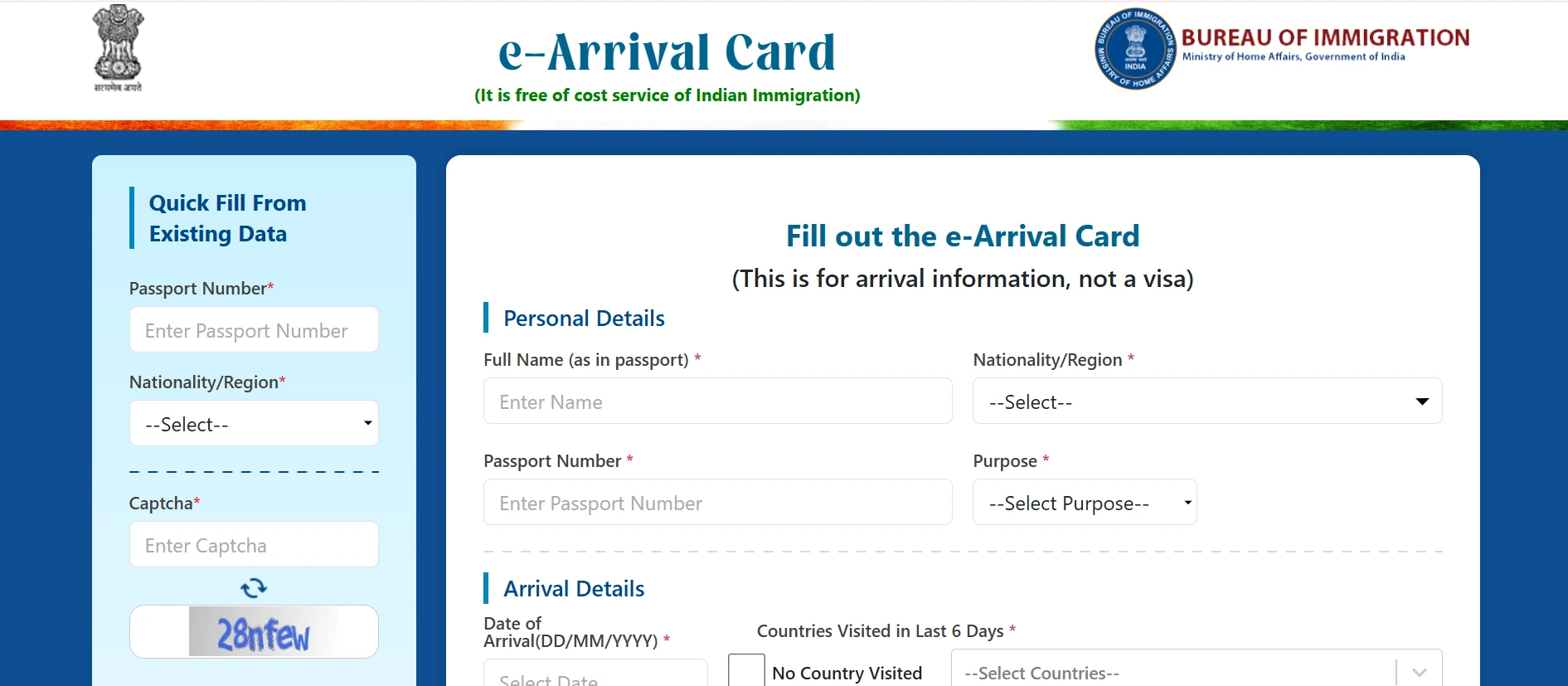
3. The e-Arrival Card must be completed before boarding; not on arrival.
Since April 2026, every foreign national entering India, regardless of age, must complete the digital e-Arrival Card within 72 hours before arrival, via the official portal or the Indian Visa Su-Swagatam app. This is filled out and submitted online up to 72 hours prior to travel. Completing it from home, in advance, with time to ask for help if needed, avoids the stress of trying to navigate a digital form at an unfamiliar airport.
4. Biometrics are captured at every entry, regardless of age.
Fingerprints and a photograph are taken at the immigration counter on arrival, there is no exemption for senior travelers. Mobility considerations at busy immigration counters are worth planning for, particularly at high-traffic airports during peak season.
5. Apply earlier than the minimum, not closer to it.
Real-world India e-Visa processing currently averages 8–10 business days. For senior travelers who may be working with a family member or travel agent to assemble documents, building in extra time before the trip removes pressure from the process. Apply at least 2-3 weeks before travel rather than the bare 2–week minimum recommended for most applicants.
Practical Travel Considerations Once You Arrive
✅ Choose accommodation and itineraries with realistic pacing. India rewards slower travel - fewer cities, longer stays, built-in rest days and particularly across long-haul time zone shifts and India's heat in non-winter months.
✅ October to March remains the strongest window for senior travelers specifically, given cooler, more manageable temperatures across North India and Rajasthan. The intense heat of April through June and the humidity of the monsoon months are worth avoiding if mobility or heat tolerance is a factor.
✅ Carry printed copies of everything. Your ETA, passport photo page, travel insurance documents, and any prescription medication list in physical form, not just digital. Internet access and device battery life cannot always be relied upon at immigration counters or in transit.
✅ Register your accommodation and itinerary with a family member or travel companion, and share your printed ETA and passport details with them before departure, standard advice for any solo or independent traveler, but particularly valuable for older travelers on extended trips.
✅ Purchase a SIM card at the airport. While you are in the city, you might require internet connectivity for your calls and messages. Purchasing SIM cards from providers like Airtel, Jio will help you further.
✅ Exchange foreign currency. Rupees is the currency used in India. You might find foreign exchange counters at the airport, but if you want lower rates, prefer the credible ones in the city to exchange money. You might exchange small amount at the airport to commute to your destination or hotel.
✅ For transportation, use cabs and taxis once you step outside the airport. You will find other convenient modes for transportation like metro, AC buses and trains, e-rickshaws and others. You may book online for cabs, motorcycles, trains or AC buses, whatever feels comfortable for your journey.
A Note on Pakistani Lineage and Background Restrictions
These apply to every applicant regardless of age and are worth confirming if relevant:
➜ Applicants of Pakistani nationality, or whose parents or grandparents were born in or were permanently resident in Pakistan, are not eligible for an India e-Visa.
➜ Those with a defence, military, security, or police background, serving or retired, are similarly excluded. Neither restriction is age-dependent; both apply equally across all age groups.
The India e-Visa process treats every applicant the same way, which means the margin for a smooth application comes entirely from preparation. At IVC Visas, our team reviews every application, photo, and document before submission, a particularly valuable safeguard for senior travelers navigating digital forms, file formats, and photo specifications that are easy to get wrong on a first attempt. Both standard and express service are available to eligible nationalities.
Carrying Medications and Managing Health Conditions During Travel to India
Medication rules aren't part of the e-Visa application itself, but they're one of the most common sources of anxiety for senior travelers, and they deserve more attention than most visa guides give them.
✅ Standard prescription medicines:
India generally permits travelers to carry prescription and over-the-counter medication for personal use, provided it stays in its original, labelled packaging and is accompanied by a copy of the prescription or a doctor's letter naming the medicine, dosage, and reason for use. As a practical rule, most travelers carry no more than a 90-day supply, matched roughly to trip length, and pack it in carry-on rather than checked luggage so it isn't lost or exposed to temperature extremes in the hold. Avoid transferring pills into unlabeled organizers for the flight; customs and airport security officers rely on the original strip, bottle, or box to match the medicine to your prescription.
✅ Controlled and narcotic medications.
Certain common prescriptions, including some painkillers (codeine, tramadol), benzodiazepines, and ADHD medications such as Adderall or Ritalin, fall under India's Narcotic Drugs and Psychotropic Substances (NDPS) Act and the Drugs and Cosmetics Rules. Small, clearly personal quantities carried with a valid prescription are typically accepted, but documentation matters far more here than for routine medicines. If you take a controlled medication regularly, carry the prescription and a doctor's letter, and consider checking current guidance with your nearest Indian mission or the Central Drugs Standard Control Organisation (CDSCO) before departure, particularly for injectable medicines, insulin pumps, or CPAP-type equipment, where a letter of medical necessity is worth having on hand. Cannabis and CBD products are prohibited outright, regardless of legality elsewhere or a foreign prescription.
✅ Vaccination requirements.
There is no general vaccination requirement for entering India. The one exception is Yellow Fever: if you are arriving from, or have transited through, a country on India's list of Yellow Fever–endemic countries within the six days before arrival, you must carry an original, WHO-format Yellow Fever Vaccination Certificate. The certificate becomes valid only 10 days after vaccination and, since 2016, remains valid for life once issued, so no booster is required even for older certificates. Travelers who arrive without a valid certificate when it's required face quarantine of up to six days. If your itinerary doesn't route through an endemic country, this requirement simply doesn't apply, but it's worth checking your specific routing rather than assuming.
Before you travel: A short pre-trip visit to your own doctor to review medication quantities, request an updated prescription letter, and confirm your travel insurance covers your specific conditions abroad removes most of the friction here, well before it becomes an airport-counter problem.
Wheelchair and Mobility Assistance at Indian Airports
Mobility support at Indian airports is a right, not a courtesy, for travelers who need it, but it works far better when arranged ahead of time rather than requested on arrival.
How to request it?
India's Directorate General of Civil Aviation (DGCA) requires airlines to provide free wheelchair assistance to passengers with disabilities or reduced mobility, from check-in through boarding and again on arrival. The most reliable way to secure this is to request it when you book your ticket, or at minimum 48 hours before departure, through the airline's website, app, or call centre. Airlines use service codes (commonly WCHR, WCHS, and WCHC) to match the level of assistance to what you actually need, from help across the terminal to full assistance into your seat. Walk-up requests at the airport are accommodated where possible, but advance booking is what guarantees availability, especially at India's busiest hubs during peak season.
Bringing your own mobility aid: Personal wheelchairs, including battery-powered ones, can usually be carried free of charge in addition to your regular baggage allowance. If your wheelchair is battery-powered, notify the airline in advance, since most carriers require a short equipment-information form ahead of the flight to comply with battery-handling rules.
At the airport itself: Once past immigration, most major Indian international terminals (Delhi, Mumbai, Bengaluru, Hyderabad, Chennai) offer step-free access, accessible parking, and dedicated counters for passengers needing assistance, though terminal size means the walk from immigration to baggage claim or connecting gates can still be long. Requesting wheelchair or buggy assistance for the full terminal transit, not just boarding, is worth doing if walking long distances is a concern.
This is a good area for a senior traveler to lean on family or a travel companion for coordination. Booking wheelchair assistance alongside your flight, and applying for your India e-Visa and e-Arrival Card with the same advance runway, keeps the entire journey from being decided at the counter, under time pressure, on the day itself.
Start your India e-Visa application with time to spare.
Contact our team if you'd like assistance completing the form on someone's behalf. We're available 24/7 via Chat, WhatsApp, and Email.
Disclaimer: IVC Visas is an independent visa service provider. We assist with application preparation and submission to official government portals. Final visa approval decisions are made solely by Indian immigration authorities. All information is based on current regulations as prescribed by the Government of India, which may change. Always verify the latest requirements before travel.