India Visa Service Fee vs Government Fee; What Each Charge Actually Covers?

When you reach the payment stage of an India e-Visa application through a visa assistance service, you will typically see more than one charge. Some applicants expect a single number. What they see instead is an itemized breakdown of:
- Government fee
- Service fee, and
- Bank transaction charge on top of both.
The confusion is understandable. The frustration, when it isn't explained clearly, is also understandable. IVC Visas, as an India e-visa service provide and explains every component: what it is, where it goes, what you receive in exchange for it, and the one scenario where a fake "government fee" is used to scam applicants entirely.
The Three Charges- What You're Actually Looking At
When you apply for an India e-Visa, up to three separate charges can appear on your invoice:
1. The Indian government's e-Visa processing fee
2. The visa assistance service fee
3. The bank transaction charge
These are three separate things paid to three separate parties. None of them is optional for their respective stage of the process. The Indian Visa processing fee differ according to the nationality and specific visa type. IVC provides a complete India Visa fee breakdown for Sweden, Austria and many more eligible nationalities so that they can verify before starting the India e-visa application.
The Indian Government's e-Visa Processing Fee
This is the fee set, collected, and retained entirely by the Government of India. It is paid through the official Indian e-Visa portal and goes directly to the Bureau of Immigration. No intermediary - legitimate or otherwise, holds, processes, or benefits from this fee.
The amount varies by nationality and by visa category. India uses a broadly reciprocal pricing model, what India charges a foreign national broadly reflects what that country charges Indian citizens for a comparable visa. The result is that a UK passport holder, a US passport holder, and a Brazilian passport holder may pay three significantly different amounts for the same India e-Tourist Visa. The official fee schedules - one for e-Tourist Visa applications, one for all other categories, are published on the official portal and updated periodically.
A Seasonal Discount Most Applicants Don't Know About
Nationality isn't the only thing that changes the government fee — the 30-day e-Tourist Visa also carries a seasonal rate, and it's easy to miss because it isn't advertised anywhere in the application flow itself.
- April to June: the 30-day e-Tourist Visa fee drops to as low as $10 for most eligible nationalities.
- July to March: the standard rate of $25 applies for the same 30-day e-Tourist Visa, for the same nationalities.
- The discount applies specifically to the 30-day category only; the 1-year and 5-year e-Tourist Visa fees stay fixed year-round and aren't affected by this seasonal window.
- This is set directly on the official government fee schedule, not a promotional rate offered by any service provider, and it applies automatically based on your travel dates, not something you have to request.
Practical takeaway: if your travel plans have any flexibility and you're applying for the short-stay 30-day visa, timing your trip within the April–June window can meaningfully reduce the government fee itself, independent of anything a service provider charges.
What Reciprocal Pricing Actually Looks Like, By the Numbers
The blog's point about reciprocal pricing is easier to grasp with real figures side by side. Based on the government's own published fee schedules, here's how differently nationality can affect the same 30-day / 1-year / 5-year e-Tourist Visa:
- Most nationalities (standard tier): $10 (Apr–Jun) / $25 (Jul–Mar) / $40 (1-year) / $200 (5-year) — this covers the large majority of the 166+ eligible countries.
- United Kingdom, Gibraltar, Jersey, Guernsey, Isle of Man: same 30-day and 1-year rates as the standard tier, but a notably higher $484 for the 5-year e-Tourist Visa.
- United States: standard 30-day and 1-year rates, but $160 for the 5-year option.
- Russia: standard short-term rates, but $120 for the 5-year option.
- Japan and Sri Lanka: a flatter, lower structure across the board — $10 / $25 / $25 / $25, with the 1-year and 5-year fees discounted well below the standard tier.
- A small number of countries (including Argentina, Fiji, Indonesia, Mauritius, and several Pacific Island nations) show a $0 fee across all e-Tourist Visa durations under the current schedule.
The same pattern holds for e-Business and e-Medical Visas, which run on a separate fee schedule:
- Standard tier: $120 (e-Business) / $80 (e-Medical, e-Medical Attendant, e-Ayush, e-Ayush Attendant, e-Conference) for most nationalities.
- United Arab Emirates: the highest e-Business fee on the schedule, at $415.
- United Kingdom, Gibraltar, Jersey, Guernsey, Isle of Man: $242 for e-Business and $129 across the medical-related categories.
- United States: $140 for e-Business, $100 across the medical-related categories.
- Ecuador: $240 for e-Business, among the highest outside the UK/Gulf tier.
This is why you must check the India visa fees before applying directly.
This fee is non-refundable once submitted. The official portal states this explicitly:
"India e-Visa processing fee once submitted is non-refundable as the fee is for processing of the application and is not dependent on either Grant or Rejection of Electronic Travel Authorization."
Whether your application is approved, rejected, or you change your mind about traveling after applying, the government fee does not come back. Made a mistake in India e-visa? Learn the fix through IVC before you hit submit.
The government fee covers the review and processing of your application by Indian immigration authorities. It does not cover assistance with completing the form, reviewing your documents, correcting errors before submission, or any support if something goes wrong. That is what the service fee covers.
The Visa Assistance Service Fee
When you apply through a visa assistance provider like IVC Visas rather than directly through the official portal yourself, a service fee is charged separately by that provider, not by the Indian government. This fee covers what the provider actually does on your behalf. At IVC Visas specifically, it covers:
✅ Reviewing your application form for errors before submission including name mismatches, incorrect dates, wrong visa category; all of which cause rejections the government fee doesn't refund
✅ Checking your passport photograph against the official specifications - format, dimensions, background, glasses, editing
✅ Verifying your passport bio page scan for legibility and compliance
✅ Submitting your application through the official portal correctly
✅ Tracking your application status after submission
✅ Providing support via Chat, WhatsApp, and Email if anything comes up after submission — re-upload requests, status queries, ETA discrepancies
The service fee is charged by IVC Visas, retained by IVC Visas, and is governed by IVC Visas' own terms , separate from the government's non-refundable policy.
An important distinction on express service: IVC Visas offers both standard and express service options. Express service means your application is prioritized and submitted ahead of standard queue applications; the preparation, review, and submission process is accelerated on IVC's side. It does not mean the Indian government processes your application faster. The government's processing timeline is the same for every applicant regardless of which service level was used; no legitimate provider can purchase faster government review. Any site claiming to offer "express government processing" for an additional fee is not describing a real service.
The Bank Transaction Charge
This is the component most applicants notice last and understand least.
When payment is made to the Indian government's portal, the payment processor (SBI ePay or Axis Bank) levies an additional transaction charge on the government fee amount. The official portal confirms this:
- 3% on credit and debit card payments,
- 4% on PayPal transactions.
This charge is applied by the bank, not by the government and not by IVC Visas. It appears as a line item on the payment page before you confirm. It is not negotiable, not waivable, and applies to every transaction.
If you apply through IVC Visas, your invoice will show the government fee and the bank transaction charge combined as the amount going to the Indian government's portal, and the IVC service fee separately. The total you pay covers all three components.
Why This Matters Beyond Transparency
Understanding the fee structure protects you from a specific and well-documented scam.
Fraudulent websites, many of which appear legitimate, collect an inflated "government fee" from applicants and pocket it. They do not submit the application to the Indian government at all, or they submit a version so poorly completed that it is immediately rejected. The applicant has paid, received nothing, and has no recourse because the site is not a legitimate operator.
The Government of India has addressed this directly on the official portal:
"Government of India does not make any provision for charging any emergency fees or additional fees for grant of any emergency or express e-Visa. Government of India advises the applicants not to believe or fall into the trap of unscrupulous elements who claim speedy or emergency grant of e-Visa and charge money for it."
The markers of a legitimate visa assistance service are straightforward: the government fee is paid through the official portal, the service fee is disclosed separately and upfront, and no claim is made about influencing or accelerating the government's own review process.
What You Are and Are Not Paying For, Summarized
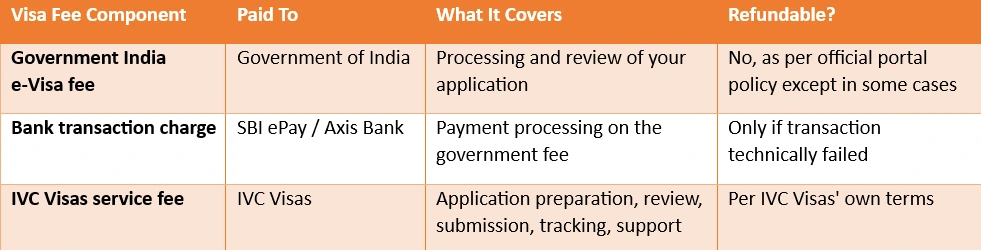
The Cost of Getting It Wrong Without Assistance
The government fee is non-refundable. A rejected application, due to a non-compliant photo, a name mismatch, a wrong category, or a blurry passport scan can costs the full government fee with no route back. The most common rejection causes are all preventable with a proper pre-submission review.
For many nationalities, the government fee alone is significant enough that a single rejection costs more than the IVC service fee that would have prevented it. Viewed that way, the service fee is not an addition to the cost of applying — it is a protection against the cost of reapplying.
Check current pricing for your nationality and visa category before applying, review the most common application mistakes that cost applicants their government fee, and start your application when you're ready.
Contact IVC if you have questions about fees before submitting.
Disclaimer: IVC Visas is an independent visa service provider. We assist with application preparation and submission to official government portals. Final visa approval decisions are made solely by Indian immigration authorities. All information is based on current regulations as prescribed by the Government of India, which may change. Always verify the latest requirements before travel.