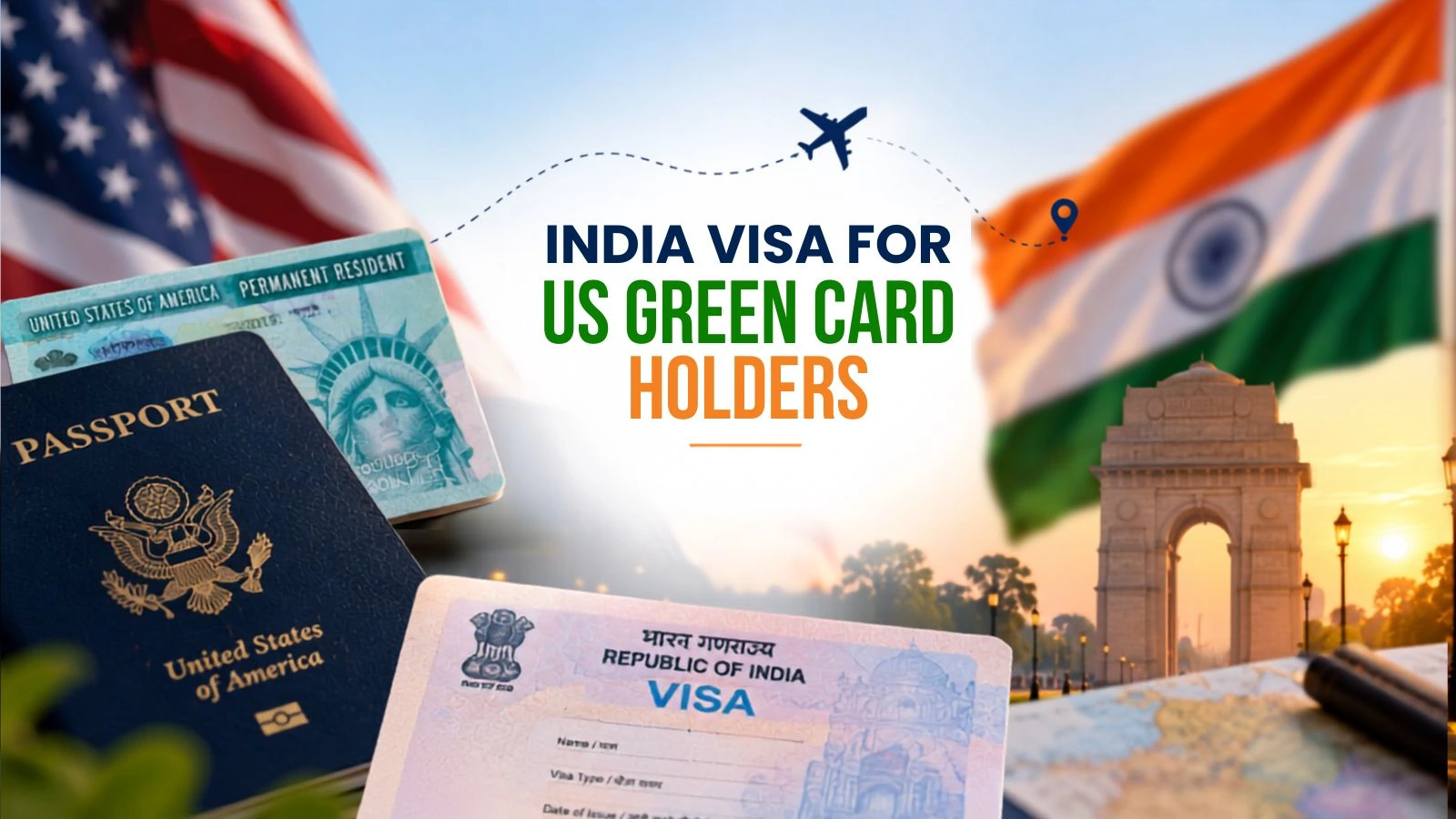
If you hold a US Green Card and you're planning a trip to India, the first thing to understand is also the thing most likely to confuse: your Green Card has no bearing on your India visa requirements. It is not a passport. It does not represent a nationality. India's visa system does not recognize "US permanent resident" as a category at all.
Your India visa eligibility is determined entirely by the passport you hold: Indian, Chinese, Nigerian, Filipino, Mexican, or whichever nationality your actual travel document represents. Living in the United States, working legally in the United States, and holding a Green Card changes none of that. This blog exists specifically to clear up that confusion and walk Green Card holders through exactly what applies to them.
Your Passport Nationality Is What Matters! Not Your Green Card
A US Green Card (Permanent Resident Card) confirms your right to live and work permanently in the United States. It is issued by US Citizenship and Immigration Services. It is not a travel document recognized by any other country, including India, for visa purposes.
When you apply for an India e-Visa, the application asks for your nationality, meaning the country whose passport you hold and intend to travel on. A Green Card holder who is a citizen of, say, the Philippines applies using their Philippine passport, under the Philippines' eligibility and fee schedule. A Green Card holder who is a citizen of Niger Republic applies using their country's passport, under Niger's terms. Your US residency status does not appear anywhere on the India e-Visa application form, and it has no bearing on your approval, your fee, or your visa category.
This means the practical starting point for every Green Card holder is the same: identify your actual passport nationality, then check that nationality's eligibility with IVC Visas or at the official portal of the India Visa before doing anything else.
Green Card Holders of Indian Origin
A significant number of US Green Card holders are people of Indian origin; either Indian-born individuals who later obtained US permanent residency, or their foreign-born children. For this specific group, the right question isn't "which visa category do I need"; it's "do I need a visa at all, or am I eligible for OCI?".
This is because OCI Cardholders are exempt from getting an India Visa.
Overseas Citizen of India (OCI) status is also not a visa; it's a lifelong entry and residency benefit for eligible individuals of Indian origin, and OCI cardholders are permitted to enter India regardless of which country's passport they hold. If you qualify for OCI, it is almost always the better route than repeatedly applying for tourist visas, since it grants effectively unlimited entry for life rather than a time-limited visa.
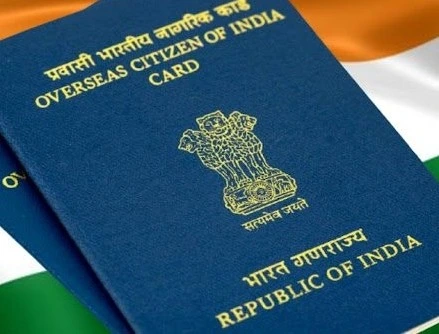
You may be eligible for OCI if:
- You are a person of Indian origin who held an Indian passport at any point and later became a naturalised citizen of another country
- You are the child or grandchild of someone who was an Indian citizen
- You are a foreign spouse of an Indian citizen or of an OCI cardholder, married for at least two continuous years before applying
You are explicitly not eligible for OCI if:
- You, or either of your parents, grandparents, or great-grandparents, is or was a citizen of Pakistan or Bangladesh
- You have served, or are serving, in a foreign military or police force
If you're a Green Card holder of Indian origin and think you might qualify, check OCI eligibility before defaulting to an India e-Visa application because it's a fundamentally different, and generally more convenient, long-term solution.
OCI applications are handled through Indian consular services, not through the India e-Visa portal, and fall outside the scope of what IVC Visas processes.
What if You Don't Qualify for OCI?
If your passport nationality doesn't qualify for OCI, or you're a Green Card holder who isn't of Indian origin at all, you apply for the standard India e-Visa exactly as any applicant of your actual nationality would, with no modifications, exceptions, or additional steps related to your US residency.
The India e-visa process:
1. Confirm your eligibility based on your passport's nationality; not your Green Card, not your US address.
Start by checking whether your specific passport nationality is on India's eligible-country list for the e-Visa scheme. This list currently covers well over 165 countries, but a small number of nationalities such as Pakistan and Bangladesh, are excluded entirely, regardless of where the applicant currently lives or works.
2. Choose the correct visa category for your actual purpose in India.
The India e-Visa system covers nine categories in total. Most Green Card holders traveling to visit family, for tourism, or for a short cultural or wellness trip will use the e-Tourist Visa, available in 30-day, 1-year, and 5-year durations. Those traveling for meetings, trade exploration, or conferences use the e-Business Visa. Others fall under e-Medical, e-Student, e-Conference, or one of the remaining specialized categories depending on the specific purpose of the trip. Selecting the category that matches your actual purpose matters; a mismatch between declared purpose and actual activity in India is treated as a condition violation, not a technicality, regardless of your residency status anywhere in the world.
3. Apply using your actual passport details; the ones for the passport you'll travel on.
Your passport number, issue date, and expiry date entered on the form must match the specific physical passport you intend to carry to India. If you hold more than one valid passport (some countries permit this under specific circumstances), apply using the one you'll actually travel with, and don't mix details between two different documents.
4. Upload the standard required documents.
For most e-Tourist Visa applications, this is limited to a scanned passport bio page and a compliant passport-style photograph; no additional documentation tied to a Green Card or US residency status is required or accepted as a substitute for standard requirements. Business, medical, or other specialized categories carry their own additional document requirements specific to that category, identical to what any other applicant of your nationality would need to provide.
5. Pay the fee applicable to your passport's nationality.
India's e-Visa fees vary significantly by nationality under a reciprocal pricing structure set by the Government of India. A Green Card holder pays exactly what any other applicant carrying the same passport would pay: your US residency, US-issued payment card, or US billing address has no effect on the fee charged. A bank transaction charge (currently 3% for card payments, 4% for PayPal) applies on top, identically across all applicants regardless of residency.
6. Receive your ETA and travel on the same passport used to apply.
Once approved, download your Electronic Travel Authorization directly from the government portal, not from your approval email, which is a separate document, and print a physical copy to carry alongside your passport.
There is no separate "Green Card holder" queue, no different processing timeline, and no special documentation requirement tied to permanent resident status anywhere in the official India e-Visa system. Learn how to apply for an India e-visa as a US citizen with IVC Visas:
Applying From Within the United States: What Actually Matters?
Green Card holders applying from a US address sometimes assume their residency status needs to be disclosed or documented somewhere in the process. It doesn't. What genuinely matters when applying from the US:
✅️ Your mailing and contact address on the form can reflect your US residence — this is simply where you can be reached, not a nationality declaration.
✅️ Your payment method works the same as for any applicant — a US-issued card is accepted regardless of your nationality.
✅️ Your passport must still meet the standard requirements — minimum 6 months validity from your intended India arrival date, at least 2 blank pages, and it must be an ordinary passport (not diplomatic, official, or a Green Card itself, which is not a travel document at all).
✅️ If you're applying on behalf of family members with different passport nationalities — a common situation in mixed-nationality US households — each person applies individually, under their own passport's eligibility, fee schedule, and category requirements. There is no combined "US household" application.
A Note on Restricted Nationalities:
Some Green Card holders carry passports from countries that are not eligible for the India e-Visa system at all, regardless of how long they've lived in the US. Notably, Pakistani and Bangladeshi passport holders are not eligible for the India e-Visa and must apply for a regular visa through the Indian Mission, following the same process any Pakistani or Bangladeshi national worldwide would follow. A US Green Card provides no exception or workaround to this rule. If this applies to you, you must visit
What Doesn't Change Once You're Approved:
Every standard India e-Visa rule applies identically to Green Card holders as to any other applicant of their nationality:
📌 entry points: Your India e-Visa is valid only through the government's designated international airports, seaports, and land ports. Where you're departing from a US city, a layover through Europe or the Gulf, or a connecting flight from a third country entirely has no bearing on this. The visa is tied to your entry point in India, not your point of origin.
📌The e-Arrival Card is still mandatory, completed within 72 hours before arrival via the official portal or the Indian Visa Su-Swagatam app, regardless of your US residency, your Green Card, or how many times you've previously traveled to India. This applies identically whether you're a first-time visitor or someone who visits annually.
📌Non-extendable, non-convertible: The same rule applies with no exception carved out for permanent residents of any country. If your circumstances change mid-trip, you decide to extend your stay, or your purpose shifts from tourism to something requiring a different category, exiting India and reapplying from outside the country is the only route, exactly as it would be for any other e-Visa holder of your nationality.
📌Same passport rule: You must travel on the exact passport used to apply, start to finish. If you renew that passport before traveling, carry both the old and new copies with you. The old one because it's the document your visa is linked to, the new one because it's your current valid travel document. Your Green Card itself carries no weight at Indian immigration in either scenario; officers are checking your passport and your ETA, not your US residency card.
📌Biometrics and background checks apply identically. Under India's Immigration and Foreigners Act 2025, biometric data collection on arrival- fingerprints and facial recognition applies to all foreign nationals regardless of country of residence. A Green Card holder is processed through the same biometric and immigration screening as any other traveler holding the same passport nationality, arriving from anywhere in the world.
📌FRRO registration rules, where applicable, follow your visa category; not your residency. If you're on an e-Business Visa or another category with a 180-day continuous-stay threshold, the same FRRO registration obligations apply to you as to any other holder of that visa category. Living in the US beforehand doesn't change the calculation once you're in India.
The pattern across every one of these rules is consistent: India's immigration system tracks your passport nationality and your visa category. It has no field, no checkbox, and no separate process anywhere for "US permanent resident." Once you understand that, the rest of the post-approval experience is identical to what any other traveler with your same passport goes through.
The Bottom Line for Green Card Holders
Forget the Green Card entirely when thinking about your India visa. Ask instead: what passport do I hold, and does that nationality qualify for OCI or the e-Visa? For most Green Card holders, the answer leads straight to a standard India e-Visa application under their actual nationality, with US residency playing no role whatsoever in eligibility, fees, or process.
At IVC Visas, we review applications from Green Card holders and every other nationality identically — checking your passport details, photo, and documents against the correct requirements for your actual nationality before submission.
Start your application with IVC when ready!
Contact our team if you're unsure whether you qualify for OCI or a standard India e-Visa; we can help you figure out the right route before you apply.
Disclaimer: IVC Visas is an independent visa service provider. We assist with application preparation and submission to official government portals for India e-Visa applications. OCI registration is a separate process handled through Indian consular services and is outside the scope of what IVC Visas processes. Final visa approval decisions are made solely by Indian immigration authorities. All information is based on current regulations as prescribed by the Government of India, which may change. Always verify the latest requirements before travel.