India e-Visa Refund Policy: Can You Get Money Back?
The short answer is: rarely. The India e-Visa processing fee is officially non-refundable in almost every scenario. But there are two specific situations where money does come back, both involving technical payment errors, not visa decisions. Understanding exactly where the line falls prevents confusion, unnecessary escalation, and wasted time.
Let's learn with IVC Visas!

The Official Rule: Non-Refundable Once Submitted
The official portal states this unambiguously in two separate places:
"India e-Visa processing fee once submitted is non-refundable as the fee is for processing of the application and is not dependent on either Grant or Rejection of Electronic Travel Authorization (ETA)."
The Visa fee pays for the processing of your application; not for a guaranteed outcome. Whether your India e-Visa is granted, rejected, or you choose not to travel after applying, the processing fee does not come back. This applies to every category-
e-Tourist, e-Business, e-Medical, and all others; and to every eligible India e-visa applicant from South Africa, Belgium, Portugal and other 170 countries.
There is no appeal route, no goodwill refund, and no exception for personal circumstances such as illness, cancelled flights, or a change in travel plans.
Situations Where a Refund is Possible!
Both are payment processing errors and not related to India visa mistakes.
Situation 1 | Payment Deducted, No Confirmation Received
If your card was charged but the portal failed to show a payment success page, typically due to a connectivity drop or browser timeout at the redirect stage — the official guidance is:
"If the applicant does not receive any payment success message even after card account has been charged, a refund shall be initiated after a due reconciliation process to the applicants' card account."
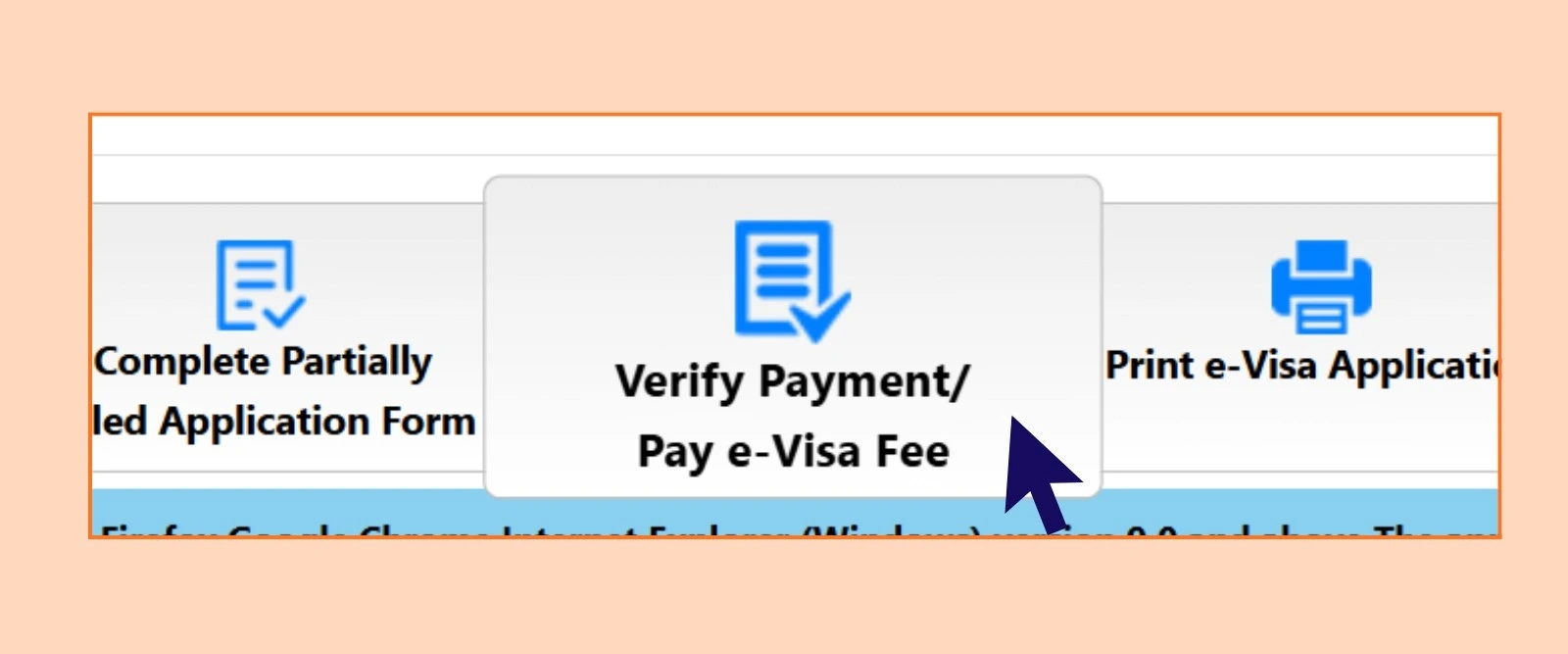
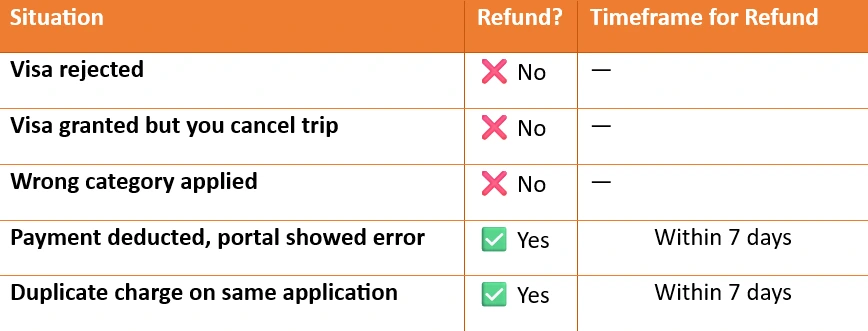
Before assuming a refund is needed, use the 'Verify Payment / Pay e-Visa Fee' tab on the official portal to check whether the transaction was actually registered as successful. If it was, your application is in the system. If the status shows 'failed', the debited amount will be refunded within 7 days via the payment processor's reconciliation process.
Do not immediately attempt another payment. Wait at least 30 minutes, check the status first, then retry if needed, with a minimum gap of 25 minutes between attempts on the same application ID.
What each status actually means for you:
- Paid / Successful — your application is in the system and being processed. No refund applies, no further payment is needed, even if you never saw the confirmation screen.
- Not Paid / Failed — the transaction did not complete on the portal's side. If your bank account or card statement shows a deduction despite this status, that's Situation 1 from this article, and the reconciliation-based refund applies automatically.
- Pending — the system is still reconciling with the payment gateway. This is not a final status; check back rather than initiating a new payment or a bank dispute at this stage.
Only after the status has settled into a final "Not Paid" and the reconciliation window has passed is it time to contact the payment helpdesk directly.
Situation 2 | Charged More Than Once for the Same Application
The portal's payment system is designed to charge only once per successful transaction per application ID. If a duplicate charge occurs, either through a system error or by inadvertently submitting payment twice, the official statement is:
"Any further debits shall be refunded back to the customer after due a reconciliation process, within seven (7) days of transactions."
This refund happens automatically through reconciliation. You do not need to request it manually, but if it hasn't arrived after 7 days, contact the relevant payment helpdesk directly.
Which Situation Does Not Qualify for a Refund?
To be completely clear on the common misconceptions:
❌ Visa rejected: Non-refundable. The fee is for processing, not approval.
❌ Cancelled trip: Non-refundable. The portal's FAQ addresses this directly: personal cancellation of a visit is not grounds for refund.
❌ Wrong visa category applied: Non-refundable. If you applied for an e-Tourist Visa and needed an e-Business Visa, the incorrect application fee is not returned.
❌ Change in travel dates: Non-refundable. A new application would require a new fee.
❌ Application not processed within expected time: Non-refundable. Processing delays do not constitute grounds for a fee return.
All these are basically common avoidable mistakes that could lead to India Visa rejection and non-refundable consequences. Discover such mistakes with IVC Visas.
Bank Transaction Charges - Also Non-Refundable
In addition to the visa processing fee, a 3% bank transaction charge applies to all card payments (4% for PayPal). This charge is levied by the payment processor (SBI ePay or Axis Bank) at the time of payment. It is separate from the visa fee and is also non-refundable once a transaction is completed successfully.
If a refund is initiated due to a failed transaction, the transaction charge would not have been finalized and should not appear on your statement. If you see an unexplained charge, contact your bank or the payment helpdesk.
Does Applying Through a Visa Agency Change Your Refund Rights?
This is a fair question, and the answer depends on which fee you're asking about, because two separate charges are involved when you use a service like IVC Visas.
The government e-Visa processing fee goes directly to the Indian government through the official portal, regardless of whether you apply yourself or through an agency. This fee follows exactly the rules described throughout this article: non-refundable on rejection, refundable only in the two technical payment-error scenarios, and processed through the same reconciliation timeline either way. An agency has no ability to change, expedite, or override this part of the refund policy, because the agency doesn't set it.
The agency's own service fee is a separate charge, for application review, document checking, and submission handling, and it is governed by that agency's own refund or cancellation policy, not the Indian government's. This is worth reading before you pay, since it varies by provider. IVC Visas' has its own refund policy and you can check that too!
The practical upside of applying through a reviewed service isn't a better refund policy; it's a lower chance of ever needing one. Since the government fee is non-refundable regardless of the reason for rejection, a pre-submission check that catches a wrong visa category, a non-compliant photo, or an incomplete field before you pay is the only real protection against losing that fee.
What if India e-Visa Payment Failed? And How to Avoid the Situation Entirely
Most refund situations aren't really visa problems; they're payment problems. A little preparation before you click "Pay" prevents most of them.
Only Visa and Mastercard are supported. Both official payment gateways, SBI ePay and Axis Bank, process international Visa and Mastercard transactions. American Express and other card networks are not supported on either gateway. If your only card is an Amex, it will fail at the payment stage regardless of your balance or credit limit, not because anything is wrong with your application.
International transaction blocks are a frequent, invisible cause of failure. Many banks automatically flag or decline overseas online charges as a fraud-prevention default, especially for a first-time payment to an unfamiliar merchant in India. Before applying, it's worth a quick call or app-based check with your card issuer to confirm international and online transactions are enabled. This single step resolves a large share of "payment declined" cases that otherwise look like a portal error.
One-time-password (OTP) timeouts cause silent failures. Both gateways use 3D Secure verification (Verified by Visa / Mastercard SecureCode), which sends a one-time code to your phone or banking app. If that code arrives late, or the payment page times out while you're waiting for it, the transaction can fail on the portal's side even though your bank shows no charge, or worse, shows a charge that gets auto-reversed a few days later. Keep your phone accessible and complete the OTP step promptly.
Browser and network stability matter more than they should. The redirect between the Indian Visa Online portal and the payment gateway is where most connectivity-related failures happen, the exact scenario this blog's refund Situation 1 describes. A stable, non-public Wi-Fi connection, an updated browser, and disabling VPNs or ad-blockers for the payment step all reduce the odds of a dropped redirect.
None of this affects your refund eligibility either way. These are simply the most common upstream causes of the two refund-triggering scenarios already covered above, worth knowing if you'd rather not encounter them at all.
Learn more with IVC Visas!
A checklist!
Payment Helpdesk Contacts
If a refund is due and hasn't arrived within 7 days, you may contact India Visa Payment helpdesk.
The Smarter Move? Get It Right the First Time with IVC Visas!
The India e-Visa fee is non-refundable by design. A rejected application, a wrong category, a non-compliant photo; each of these costs the full fee with no route back. At IVC Visas, we review your photo, documents, and application details before submission, catching the issues that cost applicants their fee before they reach the portal.
If you're unsure whether your application is ready to submit, contact our team before you pay.
A pre-submission review is free. A rejected application isn't.
Review your India e-Visa application with IVC Visas before you pay!
Disclaimer: IVC Visas is an independent visa service provider. We assist with application preparation and submission to official government portals. Final visa approval decisions are made solely by Indian immigration authorities. All information is based on current regulations as prescribed by the Government of India, which may change. Always verify the latest requirements before travel.